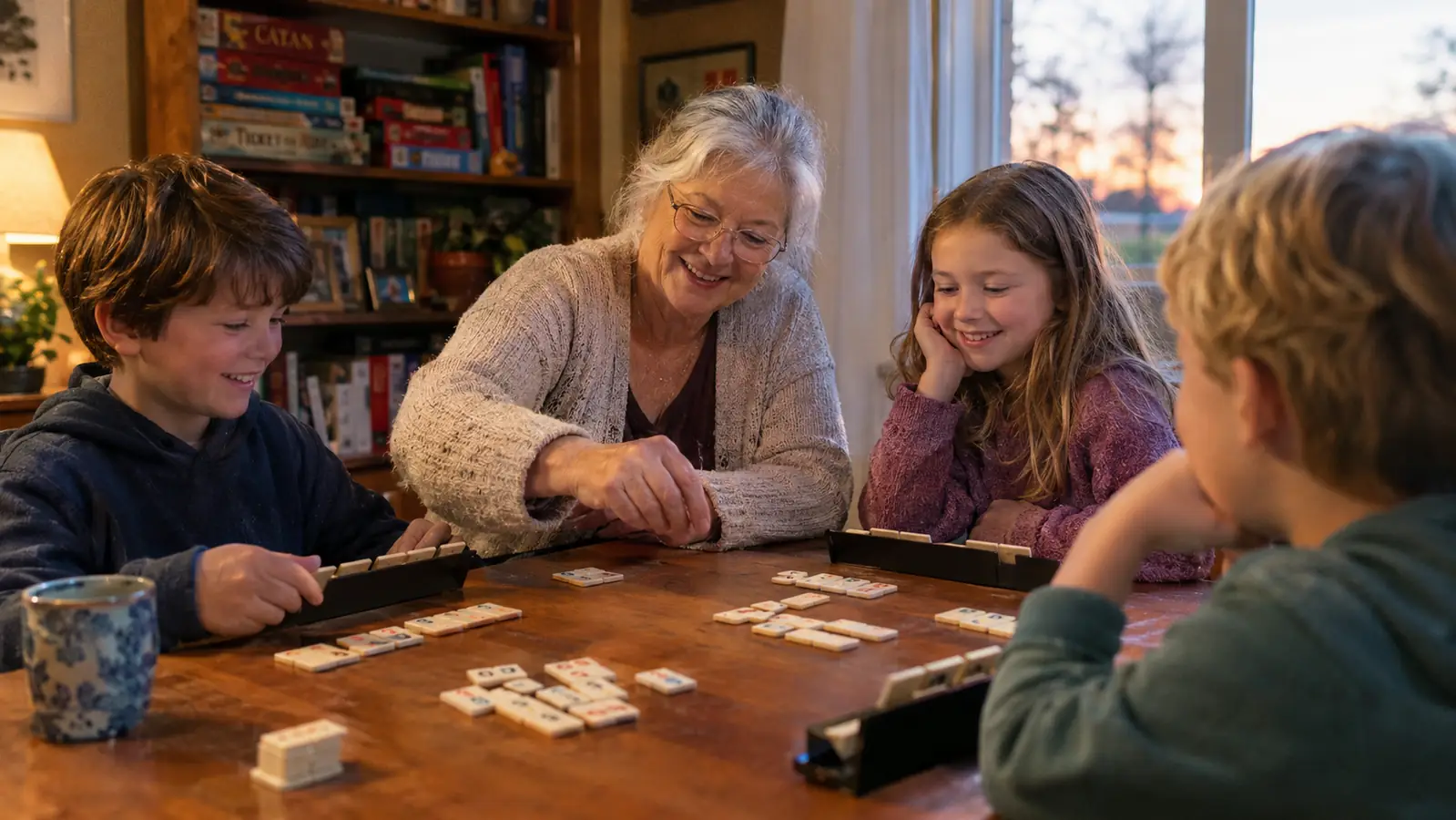
Every Sunday around six o'clock, the oak kitchen table fills up with the three grandchildren and, if I am lucky, Frank. Maya is twelve and reads above her grade level. Eli is nine and would rather build than spell. Rosie is six and loses interest fast when a game makes her feel left out. For months, two tile games have shared a shelf in the den: the MindWare Qwirkle Board Game and a well-used Scrabble set. I bought both for the same reason, I wanted a game night that worked for everyone, and I kept asking myself the same question: which one actually belongs on the table when the ages run from six to sixty-one? This is the comparison I wish someone had written for me before I bought either.
Here is the short answer. For a mixed-age table where a first grader and a middle schooler both want to win, Qwirkle is the better game. It takes about five minutes to teach, plays in roughly forty-five minutes, and lets Rosie compete on equal footing while Maya still finds room for real strategy. Scrabble is the better game when the whole table can read and spell comfortably, because its wordplay depth is something Qwirkle simply does not offer. Both are good games, and I would not call either a mistake to buy. They just solve different problems, and I think most families are actually shopping for the problem Qwirkle solves. If you only have room for one box on the shelf, start there.
How I Compared Them
A quick note on method before the table. Over the past year, Qwirkle has reached our table at least fifty times, and Scrabble has been played maybe a dozen, mostly when Maya asks for a word game after dinner. I taught both games from scratch to all three grandchildren, played two-player rounds with Frank, and paid attention to the things that matter on a busy Sunday: how long setup takes, how easy the rules are to remember between visits, how a six-year-old keeps up, and whether the box still looks respectable after fifty plays. I also kept a loose score in my head of who won and who had fun, because those were not always the same person. The table below is the honest summary of what I saw.
| Qwirkle (MindWare) | Scrabble | |
|---|---|---|
| Learning curve | Match a color or a shape; most kids understand it in five minutes | Familiar to most adults, but spelling slows down the youngest players |
| Youngest player at the table | A 6-year-old can win on merit with a little planning | A 6-year-old needs help finding words and tends to stall |
| Word building and vocabulary | No reading required, so every age plays on equal footing | Every game is a spelling lesson, a real plus for school-age kids |
| Strategy depth for experienced players | Tile counting, blocking, and set building keep adults engaged | Word knowledge and board control reward years of practice |
| Setup and cleanup | Tiles live in a drawstring bag, ready in seconds | Board, racks, and bag, then sorting letters back into place |
| Game length | About 45 minutes, easy to finish before bedtime | 60 to 90 minutes with a full table of four |
| Component quality | Thick wooden tiles with a satisfying weight | Cardboard board and plastic tiles that hold up fine |
| Player count | 2 to 4 players | 2 to 4 players |
| Portability | The whole game fits in one bag, easy for the car | The board is awkward to pack for travel |
Where Qwirkle Wins
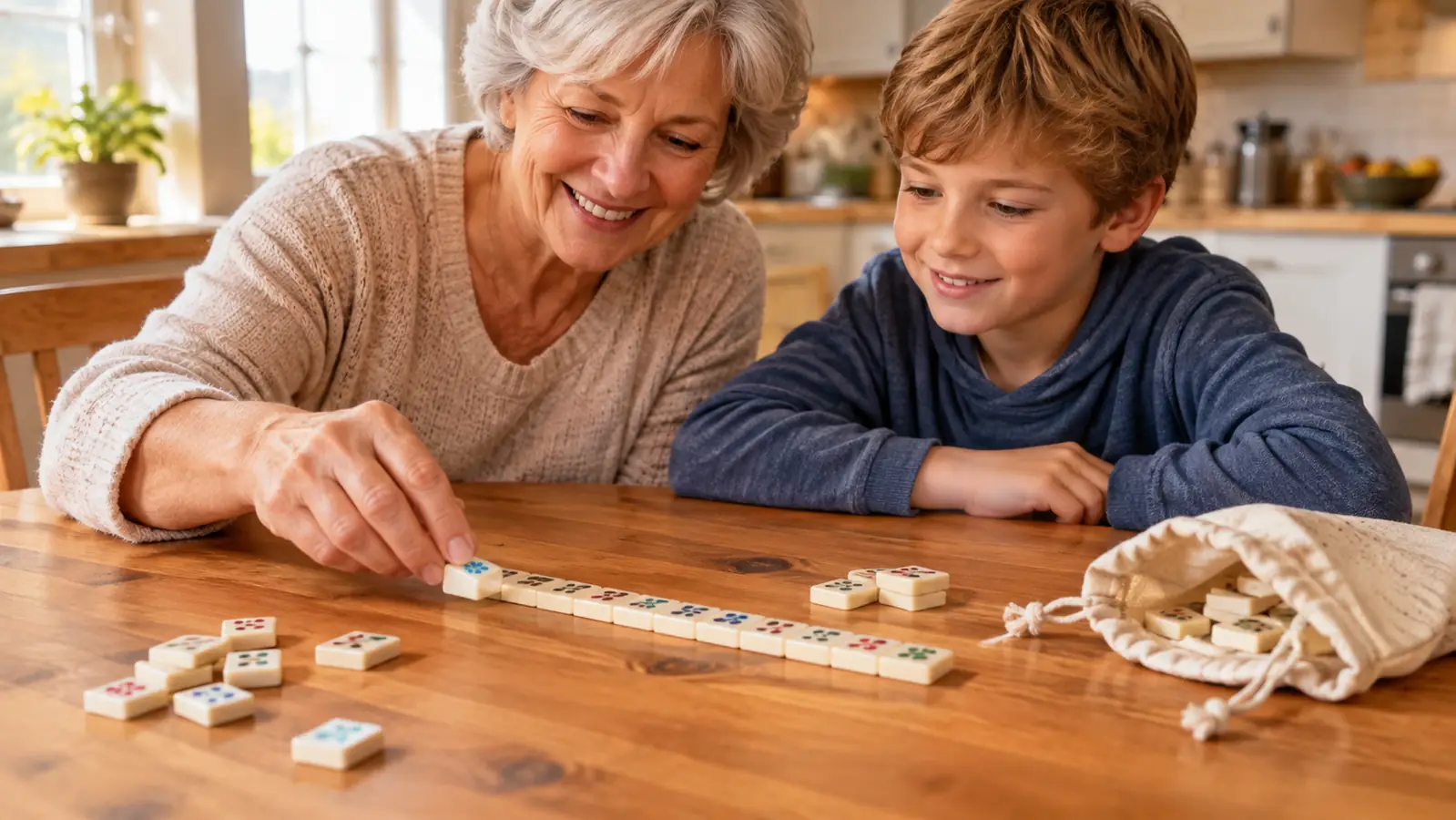
The biggest reason Qwirkle wins at our table is that it removes reading from the equation. Scrabble is, at its heart, a spelling game. You cannot play it well without a decent vocabulary, and a six-year-old does not have one yet. Rosie can read small words, but finding a good word on her rack is beyond her, so every Scrabble turn turned into me helping her, which meant she was really watching me play. Qwirkle asks for something every child already knows: matching colors and matching shapes. The rules fit on one card. Place tiles that share a color or a shape, score points for how long your line gets, and try to complete a line of six for a Qwirkle. Rosie understood it on her second turn, and by the third game she was beating Eli fair and square. Eli, who usually avoids anything that looks like schoolwork, asks for Qwirkle by name more often than he asks for dessert. Watching her crow about a win she earned herself is the whole argument for this game.
The other place Qwirkle pulls ahead is pace. Scrabble stalls. Someone is always staring at a rack, rearranging letters, asking whether a word is allowed, and arguing about whether qi counts. With four people at the table, a Scrabble game can run past ninety minutes, and by the end the youngest players have checked out. Qwirkle moves. Turns are fast because you can see your options in front of you, and a full game with all four of us lands around forty-five minutes. We finish, clear the table, and still get the kids home at a reasonable hour. The wooden tiles from MindWare also feel better in the hand than plastic Scrabble tiles, and the drawstring bag means cleanup is scoop and pull. There is real strategy under the simple rules, too. Eli has learned to watch what colors and shapes are running low, and Maya blocks her grandmother's line before it turns into a Qwirkle. For a family that plays after dinner on a school night, that combination of speed and depth matters more than you would think.
Where Scrabble Wins
Let me be fair, because Scrabble earned its place on the shelf for real reasons. The first is vocabulary. Every game of Scrabble is a quiet lesson in spelling, word roots, and the pleasure of finding the right word under pressure. Maya has learned more words from our Scrabble games than from any workbook, and she is at the age where beating Grandma at a word game is a genuine thrill. The first time she played a word that used all seven of her tiles, she jumped up from the oak table and did a little victory lap around the kitchen. Qwirkle can give you a clever pattern, but it cannot give you that specific rush. When it is just the two of us, or when Eli decides he wants a challenge, Scrabble is the game we reach for. It rewards exactly the skill it asks for, and that is a rare and honest thing in a board game.
Scrabble also offers more depth for experienced players. Once you know the two-letter words and the high-value letters, the game becomes a chess match of board control, blocking the double and triple word scores, and saving your best tiles for the right moment. Frank, who claims he does not like board games, will sit down for Scrabble if I promise not to use any word longer than eight letters. Qwirkle has its own depth, tile counting and blocking a line before your opponent finishes it, but that depth is spatial rather than verbal. If your household is full of word lovers, Scrabble will never disappoint. It is the better game for adults and older kids who want a mental workout. I just do not think it is the better game for a table that includes a six-year-old, and I say that as someone who genuinely loves both.
For mixed-age Sundays, Qwirkle is the one our table reaches for first
MindWare's Qwirkle teaches in five minutes, plays in about forty-five, and lets the youngest player at the table win on merit. It has been the most played game on our shelf for a year, and I would buy it again without hesitating.
Amazon Check Today's Price on Amazon →Who Should Buy Which
Buy Qwirkle if you have a mixed-age table, which I suspect you do, since you are reading a comparison about mixed ages. If your youngest player is between six and ten, if you want grandparents and grandchildren to play without a reading gap, and if you want a game that fits neatly into a school night, Qwirkle is the safer choice. It also travels well, so it is the one I pack when we visit the kids at their house, and it makes a dependable gift for any family with young children. The rulebook is short enough to read aloud once and then put away, which matters more than you might expect when the kids are already at the table and the clock is ticking.
Buy Scrabble if your youngest regular player is at least ten or eleven, or if the adults at your table genuinely love words. It is the better two-player game, the better game for a quiet evening, and the better game if you want something that stretches your brain. Families that already own Scrabble and enjoy it do not need Qwirkle, and families that hate word games will not suddenly love Scrabble. The honest way to put it: Qwirkle is the game I set in front of a mixed group, and Scrabble is the game I pull out when the group shrinks to two and the kids are in bed. If your table is mostly adults, buy Scrabble and do not look back. If your table is mostly kids, or kids and grandparents, start with Qwirkle.
What Surprised Me Most
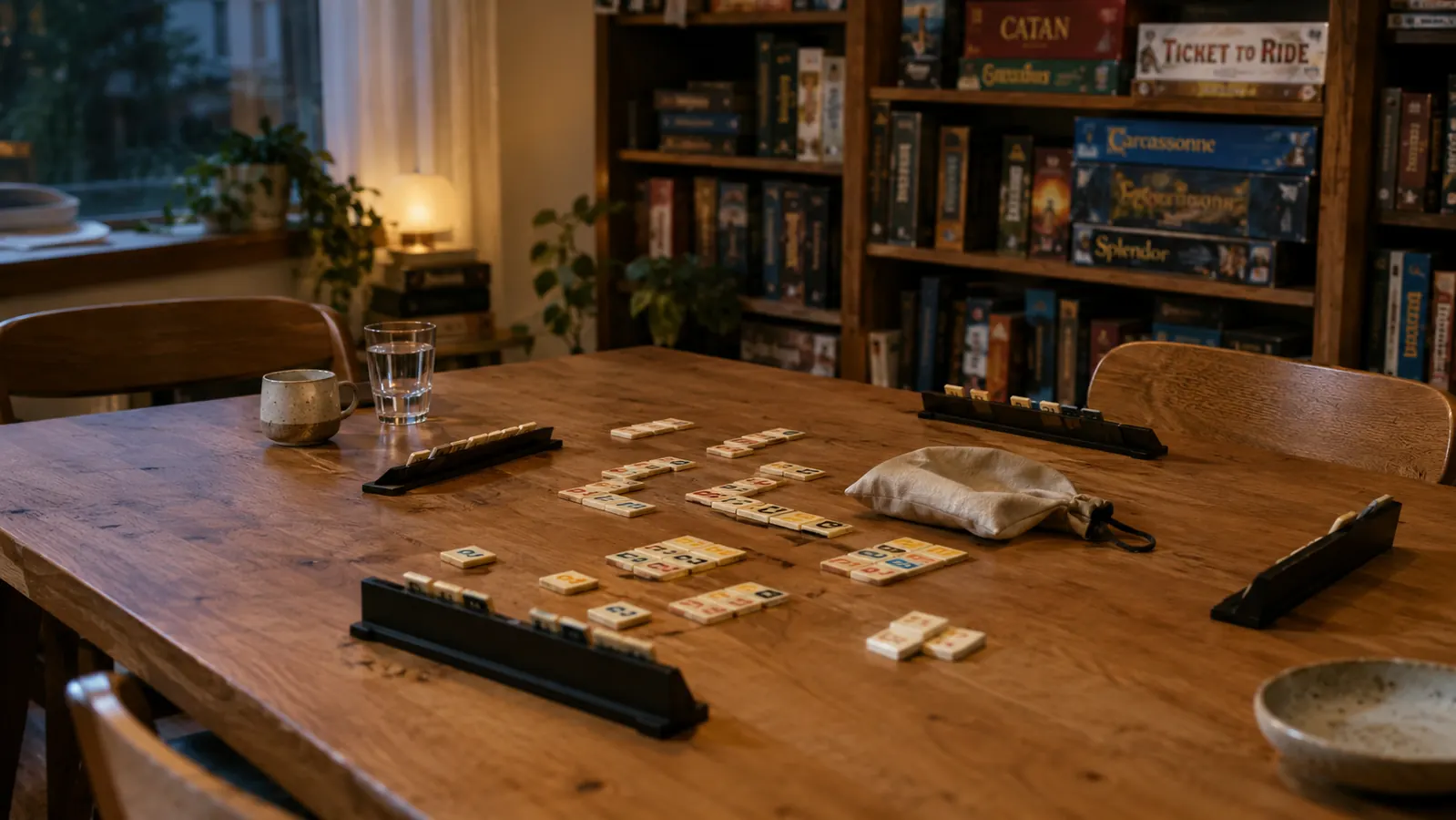
The thing that surprised me most is how often adults lose to kids in Qwirkle. I went in expecting a simple children's game, and then Maya beat me three times in a row by counting tiles and refusing to play the move I wanted her to play. The best players at our table are not the oldest. They are the ones who watch the whole board before they touch a tile. Scrabble, by contrast, almost always crowns the best speller, which means the same person wins most of the time, and that can wear on a table of mixed ages. There is something quietly fair about a game where a nine-year-old can outplan a retired librarian.
The other surprise is how much faster Qwirkle is to restart. If someone has to leave early, or if the kids want a rematch, you just scoop the tiles back into the bag and deal again. There is no scorepad, no dictionary argument, no halfway game that has to be abandoned. Scrabble can feel like a commitment, and on a school night that commitment is sometimes more than a family wants to make. Qwirkle is the game we play when we only have thirty minutes, and it is the game we play when the evening stretches out, because we can always play again.
A Note for Grandparents
If you are the grandparent in this situation, let me offer one piece of advice I learned the hard way. Do not let the youngest player lose every single game in the name of teaching them the rules. With Qwirkle, that is easy to avoid, because the game has enough luck in the tile draw that Rosie wins naturally sometimes, and those wins are what keep her asking to play. With Scrabble, I had to deliberately hold back, and Rosie could tell, which she hated more than losing. A game that lets a six-year-old win on merit is worth a lot on a Sunday evening. Qwirkle also lets me play at full strength and still lose to a lucky draw, and there is real joy in watching a child beat you honestly. That is the kind of memory that keeps a grandparent hosting game night for another year.
How They Hold Up After Fifty Plays
One thing the product photos never tell you is how a game ages. After a year of weekly use, the MindWare tiles still look new. The edges have not chipped, the surfaces have not dulled, and the drawstring bag has survived being shoved into a tote bag more times than I can count. The Scrabble set has held up too, but the cardboard board shows a crease down the middle and the plastic tiles have picked up a few scratches. Neither game falls apart, and I would not let component quality alone decide the purchase. Still, if you are the kind of person who likes a game that feels good in the hand, Qwirkle has the edge, and that edge grows with every play. Fifty games in, it still feels like a treat to open the bag.
The Bottom Line
If you only buy one of these, buy the one that fits your actual table. For us, that is Qwirkle, because it makes a six-year-old feel like a real player and still gives a twelve-year-old room to scheme. Scrabble is not the villain of this story. It is a wonderful game that simply asks for a skill the youngest members of our family have not developed yet. Keep both on the shelf like we do, and let the ages at the table decide. On most Sundays, with three grandchildren and a husband who needs convincing, the drawstring bag wins. On a quiet Tuesday night, when it is just me and Maya, the tiles come out and we spell until she wins.
Give your Sunday table a game everyone can actually play
Qwirkle from MindWare is the mixed-age tile game our family has played more than any other this year. If that sounds like your table, it is worth a look.
Amazon Check Today's Price on Amazon →