
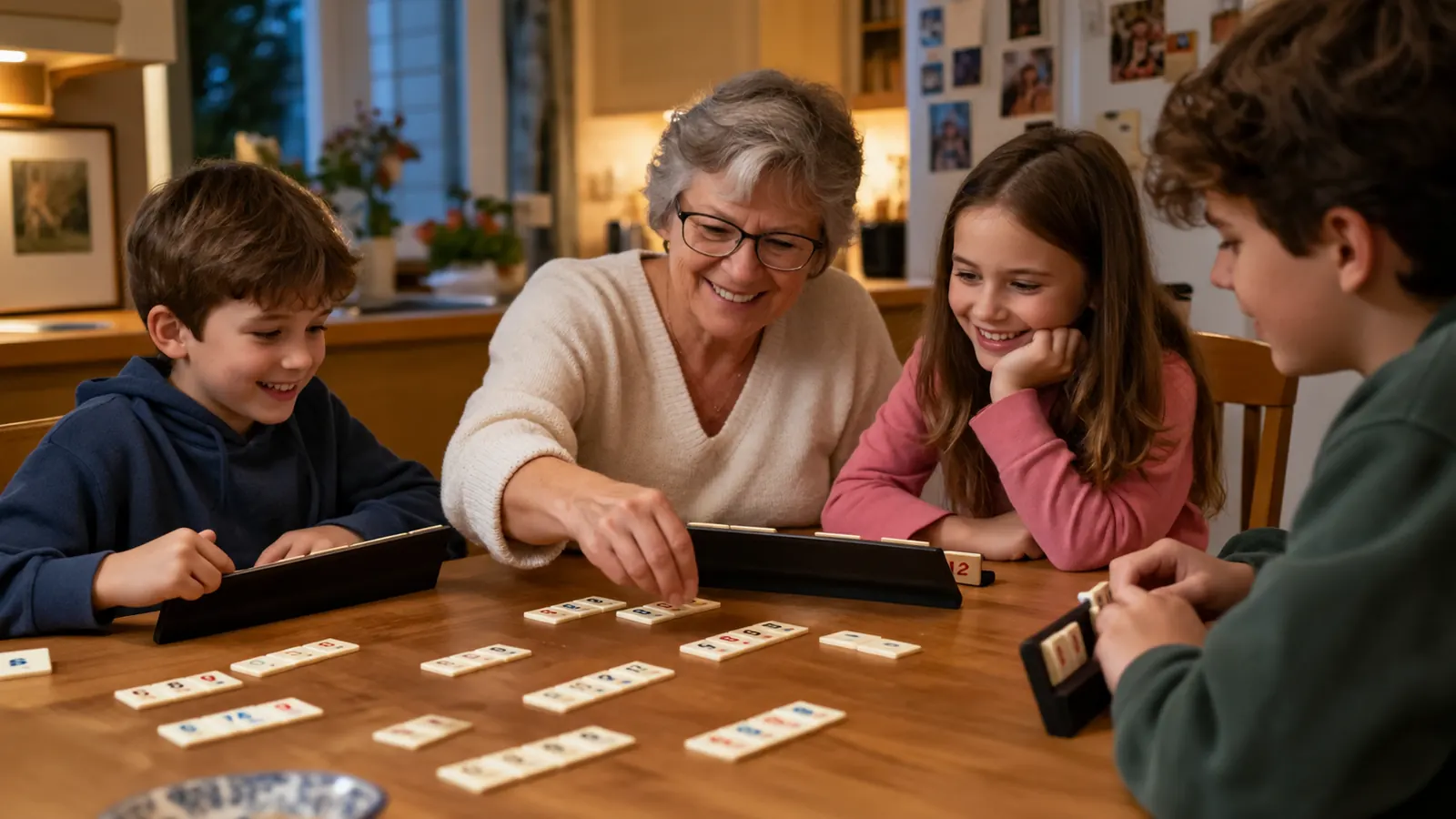
Every Sunday at six o'clock, three grandchildren land on our porch and head straight for the den bookshelf. Maya, twelve, reaches for the games with real strategy. Eli, nine, wants something he can actually win. Rosie, six, wants to be included in whatever the older two are doing. For a long time, no single box satisfied all three, and I spent more Sunday evenings than I care to admit shuffling rulebooks and refereeing arguments. Then MindWare's Qwirkle arrived in a birthday gift bag, and it quietly changed what game night looks like at the oak table.
I read the rulebook before the kids saw the box, which is what I do with every game that comes through the door. Thirty years as a school librarian taught me that the rules decide everything. Twenty minutes later I had played two solo rounds against myself, and I understood why this little box of wooden tiles has the reputation it does. Eighteen months and roughly sixty full games later, I am ready to tell you exactly how it holds up.
The Quick Verdict
A tile game that a six-year-old can learn in one round and a twelve-year-old can play with real strategy, and it has survived eighteen months of Sunday nights without a single cracked tile.
Amazon Check Today's Price →The Game That Finally Ended the 'What Should We Play?' Fight
Qwirkle has been the most-played game on our shelf for over a year. If your table has mixed ages and mixed attention spans, this is the box to try first.
Amazon Check Today's Price on Amazon →How I've Used It
Eighteen months, roughly sixty full games, and one very well-loved drawstring bag later, here is how Qwirkle actually lives in a real house. It comes out at least twice a month on Sunday nights, and it has been played by every combination of people in this family: Maya and me, Frank and Eli, all three kids, and the full crowd of two adults and three kids squeezed around the oak table that seats six.
A full game with the three kids takes us about thirty-five minutes. With just adults it runs closer to forty-five, because Frank thinks out loud and I have never met a strategy game I would not overthink. The box says ages six and up, and that is one of the few age claims I have found to be completely honest.
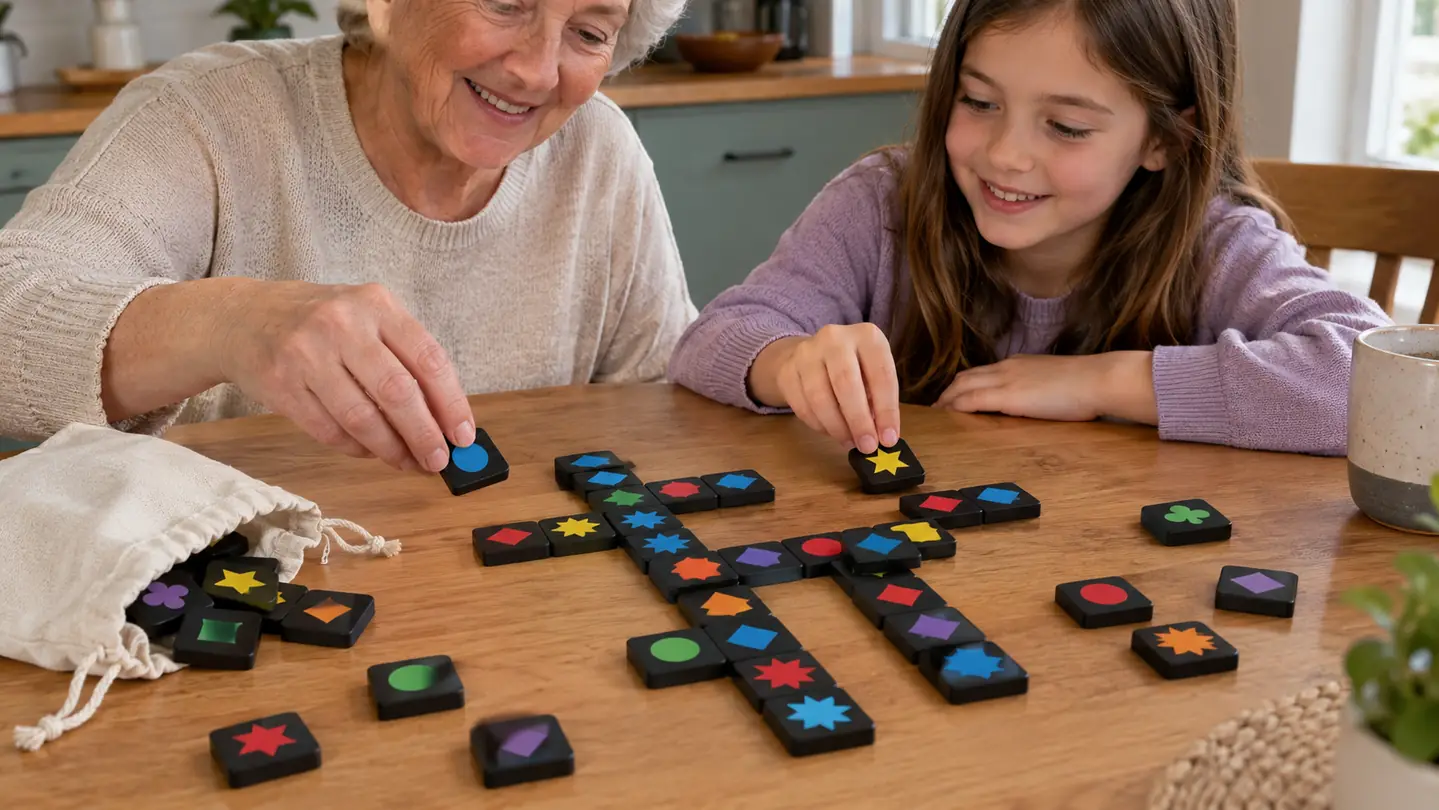
The rules take about three minutes to teach. Everyone draws six tiles from the bag. On your turn you play tiles into a line where every tile shares either the same color or the same shape, and no two tiles in that line can repeat the other attribute. Complete a line of six and you have a Qwirkle, which is worth twelve points. That is the whole game, and the whole game is more interesting than it sounds.
Why a Mixed-Age Table Loves This One
The real test for any game in this house is whether Rosie and Maya can sit at the same table playing the same game, not parallel games. Rosie plays by feel. She looks for the tile that clearly fits, the red diamond next to the red star, and she is genuinely delighted when she finds it. Maya plans three moves ahead and keeps a mental count of what is left in the bag. Both of them are playing Qwirkle, and both of them are having a good time.
That is harder to pull off than it sounds. Most games aimed at six-year-olds bore a twelve-year-old inside ten minutes. Most games with real strategy lose the six-year-old at the rules explanation. Qwirkle sits in the middle because the rules are simple enough for a first grader and the decisions are deep enough for a seventh grader, and it does all of it without requiring anyone to read.
The depth comes from a funny place. The best move in Qwirkle is often the one that looks small, because every line you build is also a line your opponent can extend. Maya learned this the hard way when she set up a beautiful row of six and Eli casually completed it for the bonus. Now she watches what she leaves open, which is a genuinely strategic habit for a twelve-year-old to build, and it carried straight over to the other games on our shelf.
How the Game Is Put Together
Here is the design that made it a Spiel des Jahres winner in 2011, the German game of the year award, and it is easy to see why once you play it. MindWare's Qwirkle comes with 108 wooden tiles, and each tile shows one of six shapes in one of six colors, so every color and shape combination exists exactly three times. On your turn you add tiles to a line, and every line must share either a color or a shape, with no repeats of the other. A line can be red circle, red square, red star, or it can be red circle, blue circle, yellow circle, but it cannot be red circle, red circle, blue circle.
The scoring rewards both building and completing. You score one point for every tile in the line or lines you touch, including the tiles already on the table, so a well-placed tile in the middle of a long line can be worth six or seven points at once. Complete a full line of six and you bank a twelve-point Qwirkle, which is the loudest moment in the game. I have seen Eli leap out of his chair to claim one.
What I admire as a former librarian is how much thinking the design packs into such a small ruleset. A six-year-old practices visual discrimination and one-to-one matching. A nine-year-old practices counting ahead and reading the board. A twelve-year-old practices denial, which is the fancy word for leaving your opponent nothing good to play. One game, three different skills, zero reading required.
How the Box Holds Up After Sixty Plays
I was a school librarian for thirty years, so I have opinions about how things hold up under constant use. The MindWare tiles are thick wooden squares, a little larger and denser than a Scrabble tile. After eighteen months and sixty games, none of our 108 tiles are cracked, chipped, or fading. The shapes are still crisp, and we have had dropped tiles, a spilled drink near the bag, and the usual rough handling that comes with small hands.
The drawstring bag is the weak spot, honestly. It is a soft canvas pouch that does the job, but after a year the drawstring loosened and I have thought about replacing it twice. It has not failed yet, it is just the least sturdy part of the package. The box itself has survived the bookshelf, the trip to the table every Sunday, and it still closes properly.
The tiles are big enough for small hands, which matters more than you would think. Rosie can pick up and place her tiles without knocking over the rows, and that keeps the game moving at her pace instead of a grown-up's pace. The shapes are still crisp after sixty games, which tells me the printing is good quality.
One honest note about play: the tiles are smooth, so long lines need the occasional nudge to stay straight. That is true of every tile game I have ever played, and the kids have learned to build from the outside in so the rows stay neat. It is a quirk, not a flaw.
What Nobody Tells You About Qwirkle
First, the luck of the draw is real. You can make smart moves all night and still lose because the bag handed your opponent exactly what they needed. That bothers some people. It does not bother me, because it means a six-year-old can win a round against a retired school librarian, and I have the score sheets to prove it.
Second, the game rewards attention more than planning. The best players in our house are not the ones who think the longest, they are the ones who notice when a Qwirkle is sitting on the board waiting to be claimed. That is a different skill than most strategy games reward, and it took me a few games to adjust my thinking.
Third, it plays beautifully with two players, which is the mode most reviews skip. Maya and I play two-player Qwirkle on quiet afternoons, and the game tightens up considerably. With fewer tiles in play, every move matters more, and the endgame gets genuinely tense. That two-player depth is a big part of why it stays on the shelf instead of getting traded away.
One small thing nobody mentions: the scoring takes a little getting used to. Because you score every tile in the line you touch, beginners routinely forget to count the tiles already on the board, not just the ones they placed. We use a simple house rule now, we score out loud and everyone at the table agrees before the next player goes. It adds thirty seconds a turn and removes all the arguments.
How It Compares to the Other Tile Games We Own
The comparison I hear most often is Scrabble, since both games are about building lines and scoring points. But Qwirkle does not use letters or words at all, and that is exactly why Rosie can play. A six-year-old cannot spell 'quixotic,' but she can absolutely match a yellow square to a yellow circle. If you are trying to decide between the two, there is a full Qwirkle versus Scrabble breakdown on this site that walks through it row by row.
We also own Rummikub, another tile game that claims to work for mixed ages. Rummikub is a fine game, but the numbers and the melding rules ask more from a six-year-old. The reason I keep reaching for Qwirkle is that the pattern matching is purely visual. You can look at the board and see the truth of it without reading a single word, which matters when one of your players is still learning to read fluently.
Tile games have quietly become the most reliable category on our shelf, and there is a whole list of reasons they suit mixed-age groups, from no reading requirements to no player elimination. Qwirkle is the one that started it for us, and it is still the one we reach for first.
People also ask me about Azul, which is prettier and a little more complex. It plays best with three or four adults, and it does not survive contact with a six-year-old the way Qwirkle does. When the whole family is at the table, Qwirkle wins. When it is just Frank and me, Azul comes out instead.
What I Liked
- Teach it in three minutes; our six-year-old played a full game on her first night
- Real strategy for older players without requiring anyone to read
- Thick wooden tiles have survived sixty games without a chip or a fade
- Plays well with two, three, or four players
- Thirty to forty-five minute games fit a school night or a Sunday evening
Where It Falls Short
- The luck of the draw can decide a game more than you would like
- The drawstring bag is the weakest component and has loosened over time
- Players who hate randomness will find the tile draw frustrating
- Nothing in the box changes for two players, the standard rules still apply
Rosie was five the first time she played, and by the end of that summer she won a full game against her big sister. That is the whole review in one sentence.
Who This Is For
Buy this for the family that sits down together with different ages and different attention spans. Buy it for the grandparent whose grandkids are at wildly different reading levels, and if you want to hear from another grandmother who found the same thing, there is a story about that on this site. Buy it for the librarian in all of us who wants a game that teaches pattern recognition and forward planning without feeling like homework. If your table has a six-year-old and a twelve-year-old and you want one game they can both love, this is the box. It has been the answer at our table for eighteen months.
One more thing: it makes a genuinely good gift. I have given three copies to friends with young families, and two of them have told me it became a regular at their tables too. That is the highest compliment a game can get, in my book.
Who Should Skip It
Skip it if your group is all adults who want a deep strategy game, because Qwirkle will feel light after a few dozen plays. Skip it if randomness genuinely ruins a game night for you, because the bag decides more than you would like. And skip it if you already own it, because you already know exactly how good it is. For everyone else, it earns its place on the shelf, and it will still be there in a year, waiting for the next Sunday night.
I will also say this to the adults who are on the fence: you will not be challenged the way a heavy strategy game challenges you, and you should not pretend otherwise. What you will get is forty-five minutes of genuine fun with people you love, and for a Sunday night with grandkids, that is the better trade.
Eighteen Months Later, It Is Still the First Box Off the Shelf
MindWare's Qwirkle has earned its spot on our den bookshelf the old-fashioned way: it gets played, week after week, by every age in this house. If your family table needs a game that works for everyone from six to sixty-one, this is the one to try.
Amazon Check Today's Price on Amazon →