
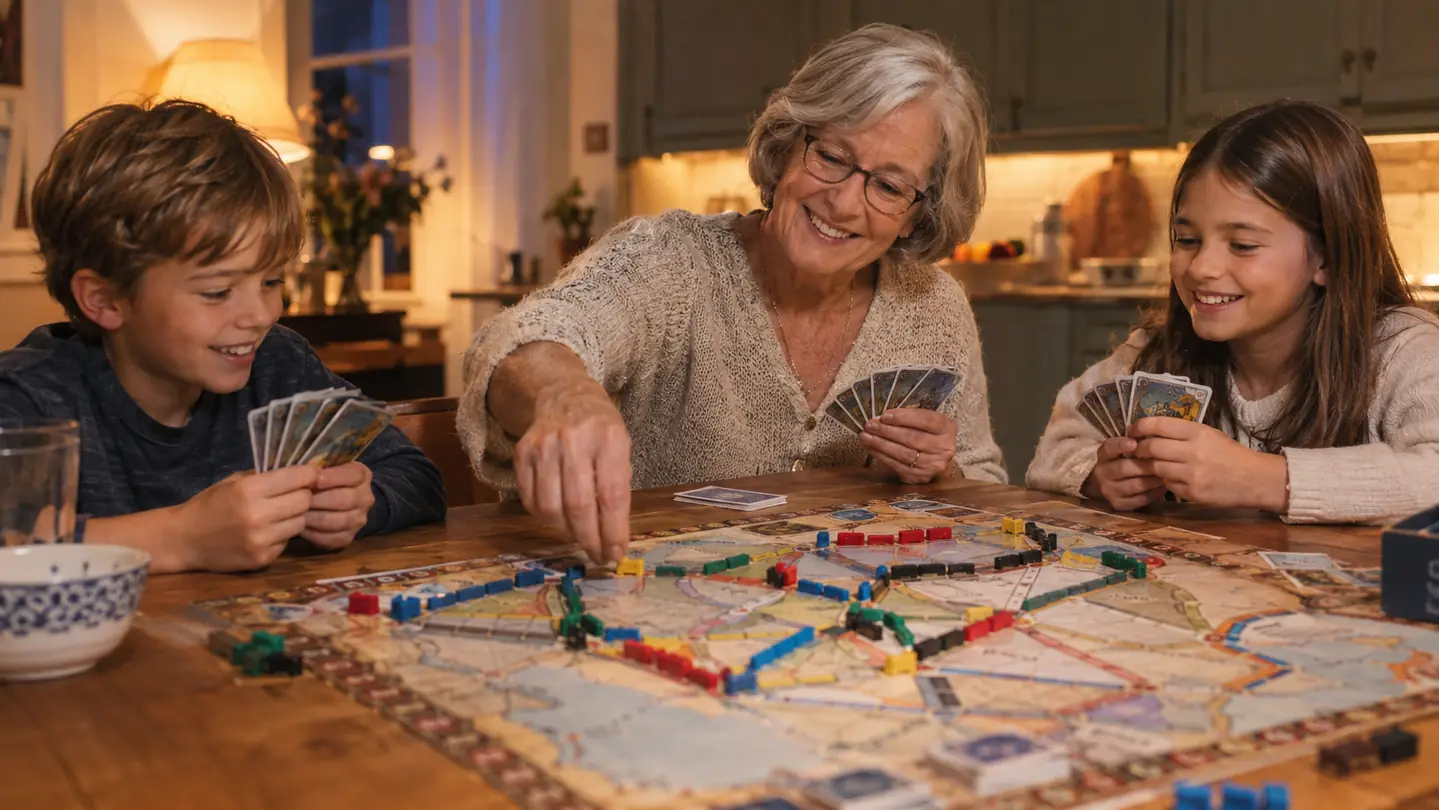
Our Sunday game night has one unwritten rule, and it has ended more board games than bad luck ever did: whatever we play has to work for a twelve-year-old who plans three moves ahead and a six-year-old who announces 'I win' before her second turn. Most games fail that test in one direction or the other, too simple for Maya or too complicated for Rosie. Ticket to Ride by Days of Wonder is the one game that passed it.
I am June, the grandmother who reads every rulebook cover to cover before the kids arrive, so this is a review from the person who sets up the game, packs it away, and keeps the score honest. I grew up on video games with my own kids in the nineties, so I respect strategy and replay value, and I am not precious about classic games. A game earns its place on our shelf by getting played, not by its reputation. We brought the Ticket to Ride box home in January 2025, and a year and roughly fifty games later, it is still the first box the kids reach for on the den shelf.
The Quick Verdict
The rare game where a twelve-year-old strategist, a nine-year-old who counts cards, and a six-year-old who cannot read all of her tickets yet can genuinely play together, and the one game my husband will sit down for without being bribed. If one box has to carry your family game night for a year, this is it.
Amazon Check Today's Price →The game that survived fifty Sunday nights at our table
If you are shopping for one board game that will actually get played, this is the one our family reached for more than any other this year. The 2025 Refresh from Days of Wonder is the current edition, and it is the one we have been playing.
Amazon Check Today's Price on Amazon →How I've Used It
The box was a birthday present for Maya, although I will admit I chose it partly for selfish reasons. I had spent the holidays watching the kids bounce off a game that was too thin for Maya and a game that was too fiddly for Rosie, and I wanted one game that could hold all three of them at the same table. Ticket to Ride kept coming up in every search for a family game, so I stopped researching and ordered it.
The first game, on the third Sunday of January, took seventy minutes and involved three reads of the rulebook, one of them by me, alone, after the kids had gone home. Maya won that first game by eight points, and I do not think I have ever seen a twelve-year-old more pleased with herself. Eli finished second and spent the ride home arguing that the longest-route bonus should have counted differently. The second game took fifty minutes. By the fourth Sunday we were finishing in about forty-five, and by spring Maya and I were playing two-player games on weekday afternoons when she stayed over.
Counting Sunday nights, holiday afternoons, and those two-player games, I put us at somewhere over fifty plays in the year. We have played with two players, three, four, and once with five when our neighbor Carol joined us. Frank has played eleven times and won six, which he brings up at dinner. The game has survived all of it, including one March evening when a cup of juice came within an inch of the board and the board won because the cup did not.

Why It Works for a Six-Year-Old and a Twelve-Year-Old at the Same Table
The rules take five minutes to explain, and that is the whole foundation of the game. On your turn you do one of three things: draw two train cards, claim a route by turning in cards of the matching color, or draw three destination tickets and keep at least one. At the start everyone draws three tickets and keeps at least two. Routes connect cities, completed tickets score points at the end, and the longest continuous route scores a ten-point bonus.
That small set of choices is what lets a six-year-old and a twelve-year-old play the same game. Rosie's turn is simple: pick a color she likes and claim the short route between two cities she knows. Maya's turn is a small logic puzzle: which routes she can afford, which tickets she can still finish, and whether to block Eli from the route he has been building toward for three turns. The game does not ask them to play at the same depth, it just lets them. One Sunday in April, Maya spent three turns quietly collecting cards while Eli built straight up the middle of the board, then she claimed the entire southern route in a single turn and took a ten-point lead. Eli stared at the board for a full minute and then laughed, which is the highest compliment a nine-year-old can pay a game.
The honest caveat is that the destination tickets require reading. Rosie could not read all of the city names when we started, so for the first few months she played with her tickets face up and one of us whispered the routes to her. That worked because the game does not punish you for playing openly. By the end of the year she was reading 'Denver' and 'El Paso' off her tickets without help, and I did not expect a board game to give us that milestone.
The two-player games with Maya taught me the other half of the game's range. With two players the board feels almost empty, and the game becomes a quiet duel about which routes you will force the other person to take. Maya beat me three games in a row last spring by watching which colors I was collecting and claiming the routes I needed before I could afford them. I have lost enough board games to know when I have been outplayed, and she outplayed me.
Setup Time, Rulebook, and How Long a Game Really Takes
Setup is genuinely quick. The board folds out and covers most of our oak table, the train cards get shuffled, each player takes a set of plastic trains and a scoring marker, and everyone draws tickets. From box to first turn is about five minutes once you know the game, and about eight the first time, because you will read the rulebook even though you told yourself you would not.
That rulebook is the quiet hero of the whole experience. Days of Wonder writes rules the way I used to write library instructions: short sentences, examples, and a picture when a sentence will not do. I read it once before the kids arrived, as I do with every game, and I did not need to open it again. Eli, who is nine, had the game figured out by the end of his second turn, and he has been the family authority on the rules ever since.
Game length is where you need to be honest with yourself. The box says thirty to sixty minutes, and that is true once everyone knows what they are doing. In our first game we forgot the rule that lets you claim a short route with any color of cards, so we all hoarded cards for the first ten minutes until I re-read the rulebook and realized we were playing a much slower game than the one on the page. The kids forgave me. A five-player game with two adults who are thinking about their routes will sit at the top of that range. For our family, forty-five minutes is the sweet spot: long enough to feel like an event, short enough that Rosie does not fade in the last stretch.
How the Box Holds Up After Fifty Plays
After a year of weekly use, the board still lies flat, and that is the first thing I check with any game because a board that curls is a board you stop reaching for. The plastic trains are small enough to be fiddly but sturdy enough that Rosie has dropped them on the tile floor more times than I can count without a single one breaking. The cards are what I worried about most, since they get shuffled constantly, and the 2025 Refresh from Days of Wonder uses a card stock that has held up far better than I expected.
The box itself is the right size for the board, which sounds obvious and is not. We own games whose boxes are half empty because the publisher wanted a bigger presence on the shelf, and games whose boxes barely close. This one closes cleanly, and the insert keeps everything in place if you pack it in the right order, which you will learn after the first time you open the box to find a pile of trains rattling loose.
The small honest complaints: the scoring track around the edge of the board is easy for a six-year-old to lose her place on, and we have stopped mid-game twice to count everyone back from the last score we were sure about. The card corners show shuffle wear after a year, which is normal for any game played this much. Neither has ever made us consider shelving the game, but you should know they are there.
The House Rules We Settled On
Every family game develops house rules, and ours did too. The first came from necessity: Rosie's destination tickets stay face up until she can read the city names on her own, which happened somewhere around the end of summer. The day she announced she did not need the help anymore was the day I realized the game had taught her something the school year had not gotten to yet. The second rule came from fairness: Maya is not allowed to claim a route that strands Rosie's train, unless she tells Rosie she is doing it first. Rosie finds this hilarious and has started doing it back to Maya.
The third rule came from Eli, who discovered he could draw fresh destination tickets mid-game to chase points and then run out of trains before he could finish them. His rule, which he proposed himself, is that nobody may draw new tickets after the halfway point. That rule tells you everything about how a nine-year-old thinks about this game. Frank's rule is simpler: he only plays after dinner, and then he wins by building one long route across the top of the board while everyone else fights over the middle.
What we did not change is worth noting too. We kept the longest-route bonus, because it is the rule that makes the last rounds exciting, and we kept the official tie-breaker, which goes to the player who completed more destination tickets. The game works as written. Every house rule we added was about our family, not about fixing something broken.
What I Liked
- A single turn is simple enough for a six-year-old and deep enough for a twelve-year-old
- Teaches route planning, map reading, and weighing risk without feeling like a lesson
- Setup takes about five minutes and the rulebook is genuinely readable
- Plays well with two, three, four, or five players
- The 2025 Refresh components have held up through a year of weekly play
Where It Falls Short
- Destination tickets require reading, so younger players need help or face-up tickets
- A five-player game runs close to an hour, which is long for the youngest players
- The scoring track around the board is easy to lose your place on
- Card corners show shuffle wear after heavy use
- A player who draws weak tickets early can feel stuck for the rest of the game
The real test of a family game is not whether the kids ask to play it on the first Sunday. It is whether they are still asking a year later. Fifty plays in, ours still is.
Who This Is For
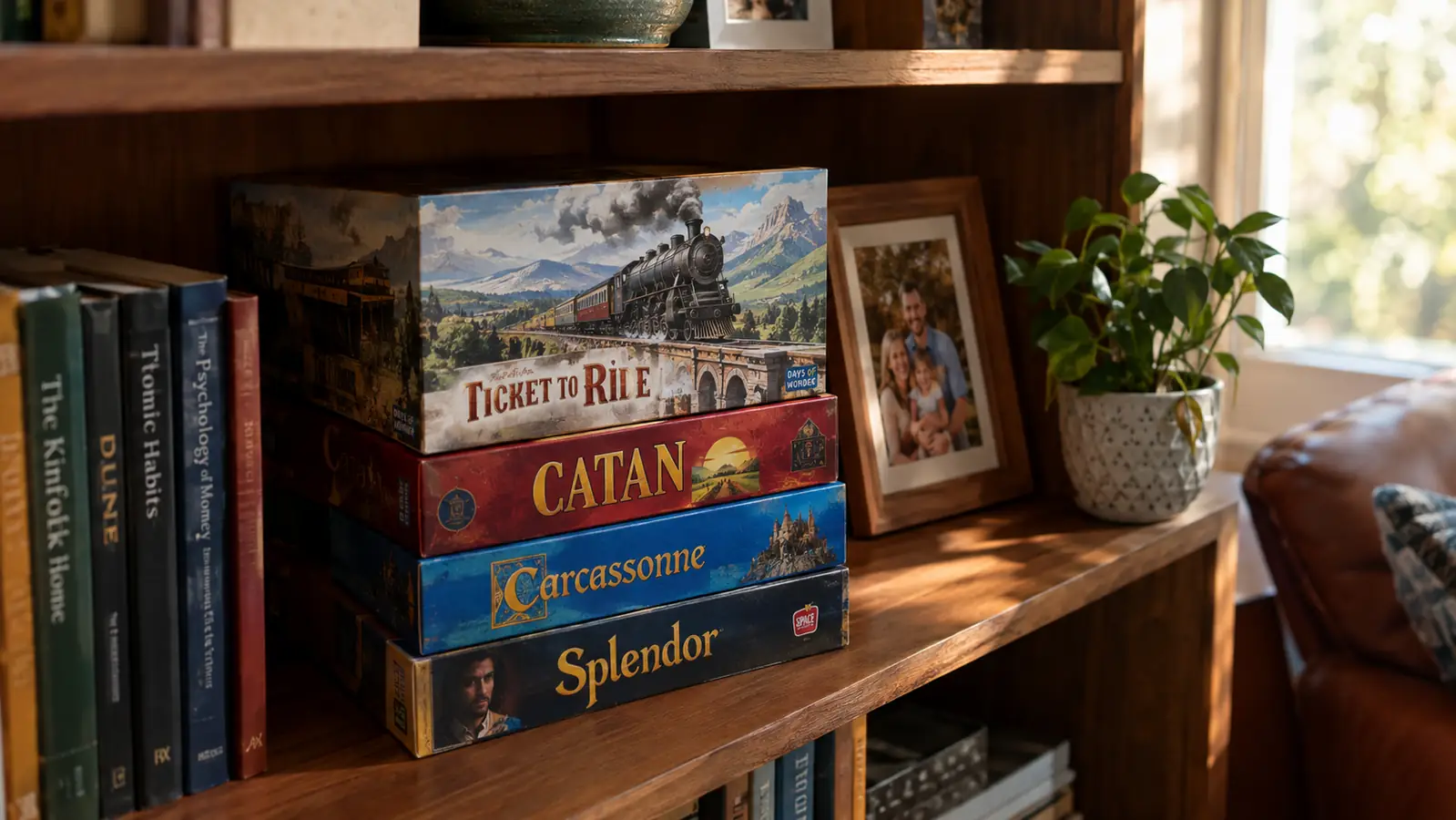
This is for the family that wants one game everyone can play, not a shelf of games that each suit one person. It is for grandparents who host the grandkids, parents whose children span a six-year age gap, and anyone who has watched a family game fall apart because the youngest player lost interest in the first ten minutes. If you are weighing this against Catan, my comparison of the two goes into the details, but the short version is that Catan rewards trading and negotiation, which is wonderful with adults and harder with a six-year-old. Ticket to Ride asks less of its youngest players and gives them just as much to enjoy.
Who Should Skip It
Skip it if your family prefers games that are over in fifteen minutes, because Ticket to Ride is a forty-five-minute commitment and it does not compress well. Skip it if you have a player under six who cannot sit through a full game, since even with help the attention span question is real. And skip it if you want a game where everyone starts even, because the luck of the initial draw matters and a young player who pulls weak tickets can feel left behind. None of that makes it a bad game. It makes it a game you should buy knowing what it is.
A year of Sunday nights says this one earns its shelf space
The 2025 Refresh is the edition we have been playing, and it is the one I would buy again. If it sounds like the right fit for your table, check today's price on Amazon.
Amazon Check Today's Price on Amazon →