
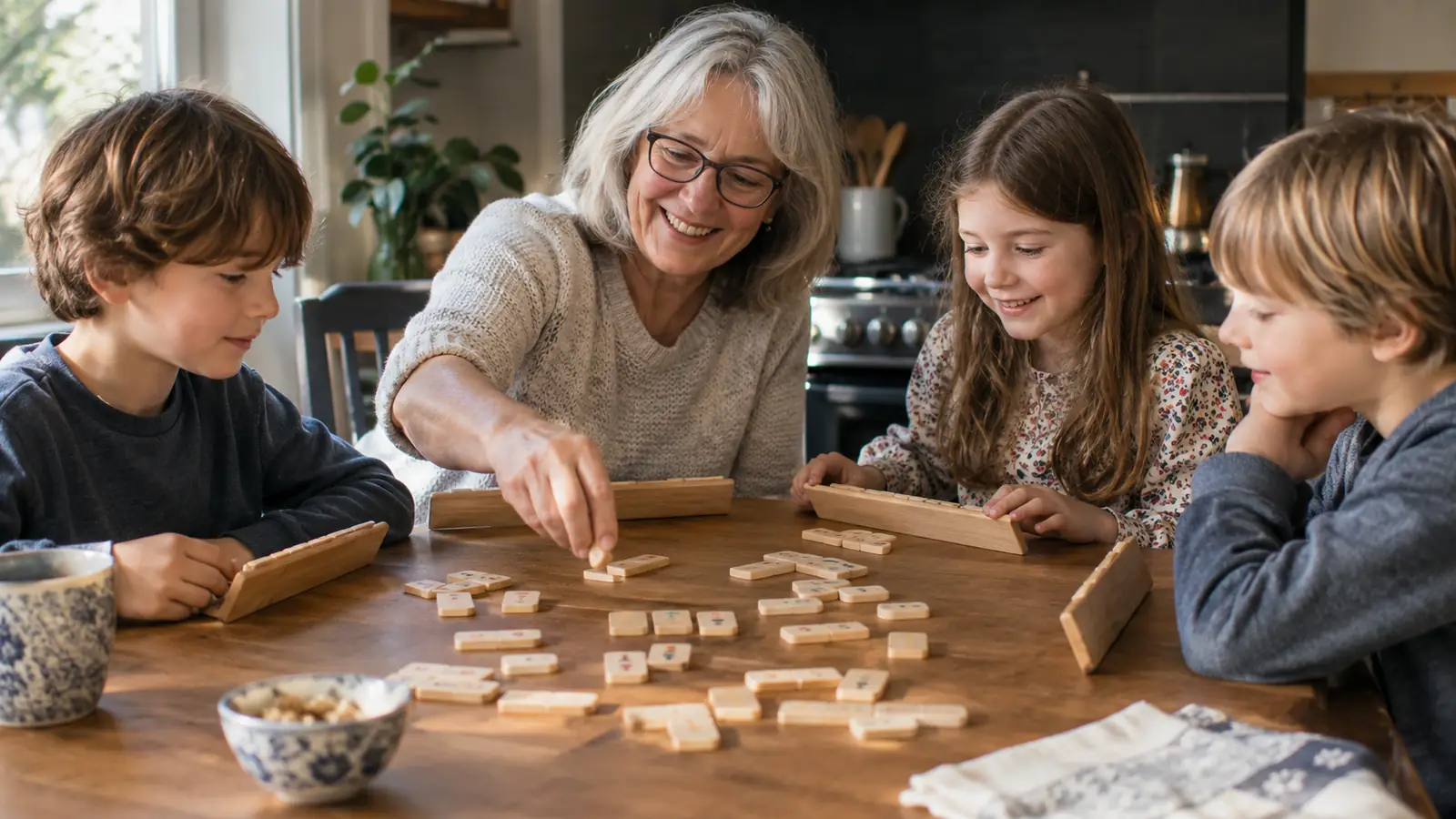
Every game on our shelf got there the same way. Someone read a glowing review, the box arrived, we played it once, and it slid to the back of the den bookshelf. Qwirkle from MindWare has survived the opposite fate. It has been played on nearly every Sunday night since last spring, and it survived because nobody read the box first. We bought it on a recommendation, dumped the tiles on the oak table, and figured it out as we went. That is the best way to meet this game, and the box does not tell you that.
What the box does tell you is thin. It says the game is for ages six and up, for two to four players, and that the goal is to score points by building rows and columns of matching shapes and colors. That is technically true and practically useless. The product page shows a 4.8 rating from more than eighteen thousand reviews, and for once the crowd is not wrong. It is also missing the same things the box is missing. It does not tell you that a six-year-old can win against a twelve-year-old on the right day, that adults will lose to children often enough to stay humble, or that the quiet strategy layer only appears around the fourth or fifth game. Those are the things I want to tell you.
The Quick Verdict
A tile game that hides real strategy inside a rulebook a first grader can follow. Worth it for any family that can handle losing to a six-year-old.
Amazon Check Today's Price →The game that survived fifty Sundays at our table
Qwirkle is the rare family game that works for ages six to sixty. It has held up on our oak table for six months and more than fifty games. Check today's price on Amazon and see if it earns a spot on your shelf.
Amazon Check Today's Price on Amazon →How I've Used It
I am a retired school librarian. Reading rules is my version of a hobby. Before every Sunday game night, I sit down with the rulebook and a cup of coffee and make sure I understand the edge cases before the kids arrive. With Qwirkle, that ritual lasted about four minutes. The entire rules sheet fits on a single folded page. I read it once, taught it to Rosie while she was still in her pajamas, and we played two full games before Maya and Eli even showed up.
Since then, Qwirkle has been the default game at our kitchen table. We have played it after big Sunday dinners, on a rainy Tuesday when school let out early, and once at a diner booth while waiting for pancakes, using the cardboard box lid as a tray. Frank, who needs to be talked into every game, has asked to play it twice. Twice. That is the highest compliment a game can earn in this house.
I keep a tally of every game we play, a habit from my library days. On the dry erase board that hangs beside the refrigerator, Qwirkle has fifty-three tally marks as of the first Sunday in June. The next closest game has eleven. I know the number precisely because I add a mark after every single game, and the kids have started arguing about whose turn it is to make the mark. Before Qwirkle, I tried other games with this exact group of three kids. One trivia game worked for Maya and bored Rosie, who could not read the cards. One card game took twenty minutes to set up and lost three pieces in a week. Both are still on the shelf, unplayed. Qwirkle was the first game all three kids agreed on without any negotiation, and the tally marks prove it was not a fluke.
I have also played it one-on-one with Maya when she stays over, and it is a different game entirely. With three kids, the table is loud and silly. With two players, Qwirkle turns quiet and almost chess-like. When it is just the two of us, Maya talks through her moves out loud, which she would never do with her brother listening. I have learned more about how she thinks from those games than from any conversation we have had. The game gives us a reason to sit across from each other with the phones on the counter. That range, from loud and silly to quiet and thinking, is the thing I keep coming back to, and it is the first thing the box never mentions.
What the Box Does Not Tell You About the Rules
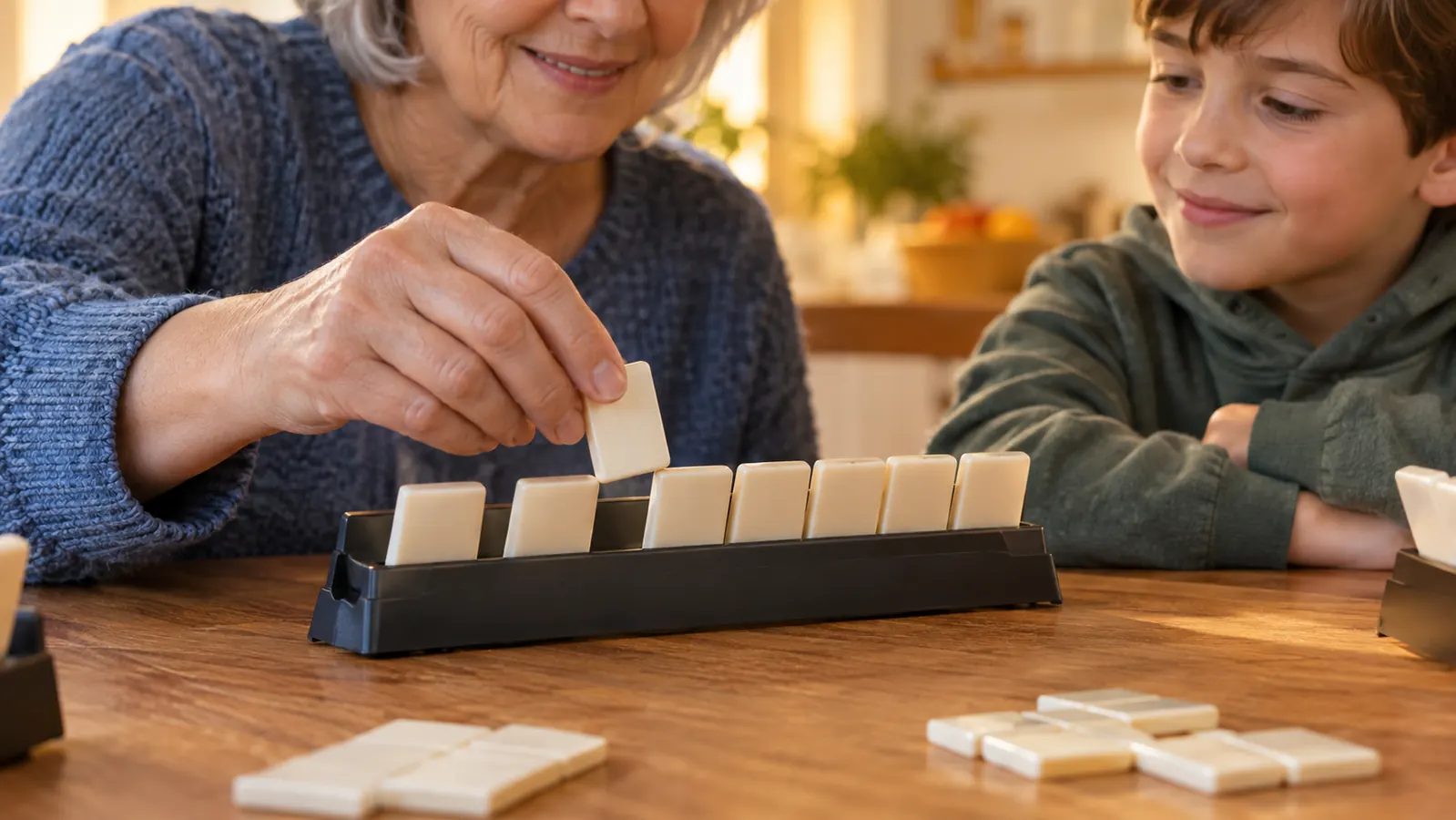
The rules are simple enough to teach in ninety seconds. On your turn, you either add tiles to the existing rows and columns, or you trade tiles in and skip your turn. A row can never contain two tiles that match on both shape and color, and it can never contain two tiles that share the same shape or the same color. Every tile you add scores a point, and a completed line of six scores six extra points, which is called a Qwirkle. That is the whole game, and MindWare keeps the rules sheet short on purpose.
What the box does not explain is how often the last move of the game changes everything. On one Sunday in February, Eli had been trailing Maya by eleven points for the entire game. He laid down a single tile that completed two lines at once, both of them full runs of six, and scored fourteen points in one move. Maya did the math, looked at the score pad, and went quiet. Eli has not stopped talking about it since.
There is one rule that trips up adults more than kids. A row can never hold two tiles that share both shape and color, so the same tile can never appear twice in one line. Frank, who plays exactly one game a month when he is talked into it, tried to place a second tile that matched an existing tile on both shape and color during his first game. I stopped him, explained the rule, and he grumbled for a full minute before winning that same game by twelve points. Rosie has never once broken this rule, because she learned it before she learned to read. Kids accept the rules as they are. Adults try to negotiate. The other thing the box leaves out is that the first Qwirkle of the night always gets a reaction. Rosie scored her first one in late September, a row of six she built without realizing it. When I explained what she had done, she stood up in her chair. That moment does not appear anywhere on the box.
The other thing the box does not mention is that the game rewards paying attention to the shared pool of tiles. Because every player draws from the same bag, the tiles you hold tell you what is left. A child who watches what everyone else plays will occasionally know exactly what is coming. That moment of dawning strategy, watching a kid realize they can plan two moves ahead, is worth more than any rulebook.
Component Quality: What Fifty Plays Do to the Tiles
The tiles are chunky, solid wood blocks that feel pleasant in the hand, and they have been through more than fifty games on our oak table without a single split or chip. The paint has held up better than I expected, which matters because the whole game depends on telling the shapes and colors apart at a glance. After six months, a few tiles show slight wear on the edges, but nothing that affects play. MindWare built this one to last.
I checked the box on the kitchen scale before the first game, out of curiosity. It weighed just over two pounds, and most of that weight is tile. The tiles are thick enough that a six-year-old can stack them like building blocks, which Rosie does whenever the game ends. The shapes are stamped into the wood rather than printed on top, so they will not rub off no matter how many hands go through the bag. One tile took a trip through a glass of water in October when Eli reached across the table, and it dried out overnight with no swelling and no lost paint. That is the kind of thing that tells you a game was built for children. The only real complaint I have is the bag, which is a plain drawstring pouch that fits the tiles only with a squeeze once the game is underway. I replaced it with a wider cloth bag from a craft store, and fishing for tiles stopped being a contact sport.
The box itself is sturdy cardboard, the kind that survives being shoved on and off a den shelf for years. The corners are rounded, which sounds like a small thing until you watch a six-year-old carry it across the kitchen. Nothing about the MindWare components feels cheap, which is more than I can say for a lot of the games that have come through this house.
The Honest Truth About Age Range and Difficulty
The box says six and up, and that is accurate in a way that surprises people. Rosie learned the rules at six because matching shapes and colors is something she already understood from sorting games at school. She does not play a deep strategic game. She plays tiles that fit, and she wins a fair share of the time because a short game with plenty of luck rewards a child who simply never stops paying attention.
Maya, who is twelve, has started playing the quiet game. She holds her tiles, watches the pool, and sets up moves two turns ahead. She beats me about half the time now, and she beat me three games in a row one Saturday in March, which I have chosen to blame on the coffee going cold. The point is that the same game entertains a six-year-old sorting shapes and a twelve-year-old counting tiles. That is rare.
The tally on the dry erase board backs this up. Since January, Maya has won fourteen games, Eli nine, Rosie seven, and I have six. Frank, who only plays when he is talked into it, has five, and two of those came on the same night in April when he finally figured out the trap I keep setting. Those numbers matter because they show the game is not rigged toward the oldest player or the adult. Rosie wins almost as often as Eli, and she does it without any strategy at all. She just never stops looking at the board. On New Year's Eve we played a four player game with Frank, Maya, Eli, and Rosie, and Rosie finished second. She did not understand why, and she did not care. Frank finished last and has been quietly studying the game ever since, which is his version of respect.
The thing nobody tells you is that the game improves as the players improve. The first few games are pleasant and light. By the tenth game, you start to see the deeper layer, the one where you decide whether to score now or hold tiles for a bigger play later. By the thirtieth game, you are setting traps, and the kids are learning to see them coming. The clearest sign came in April, when Frank asked if he could play again the following Sunday. He never asks. He just shows up. That was the moment I knew the game had gotten its hooks into this house. Eli now warns me when I am about to walk into one of my own traps, which is both helpful and humbling. The box does not warn you that you will get attached.
The Tradeoffs Nobody Mentions
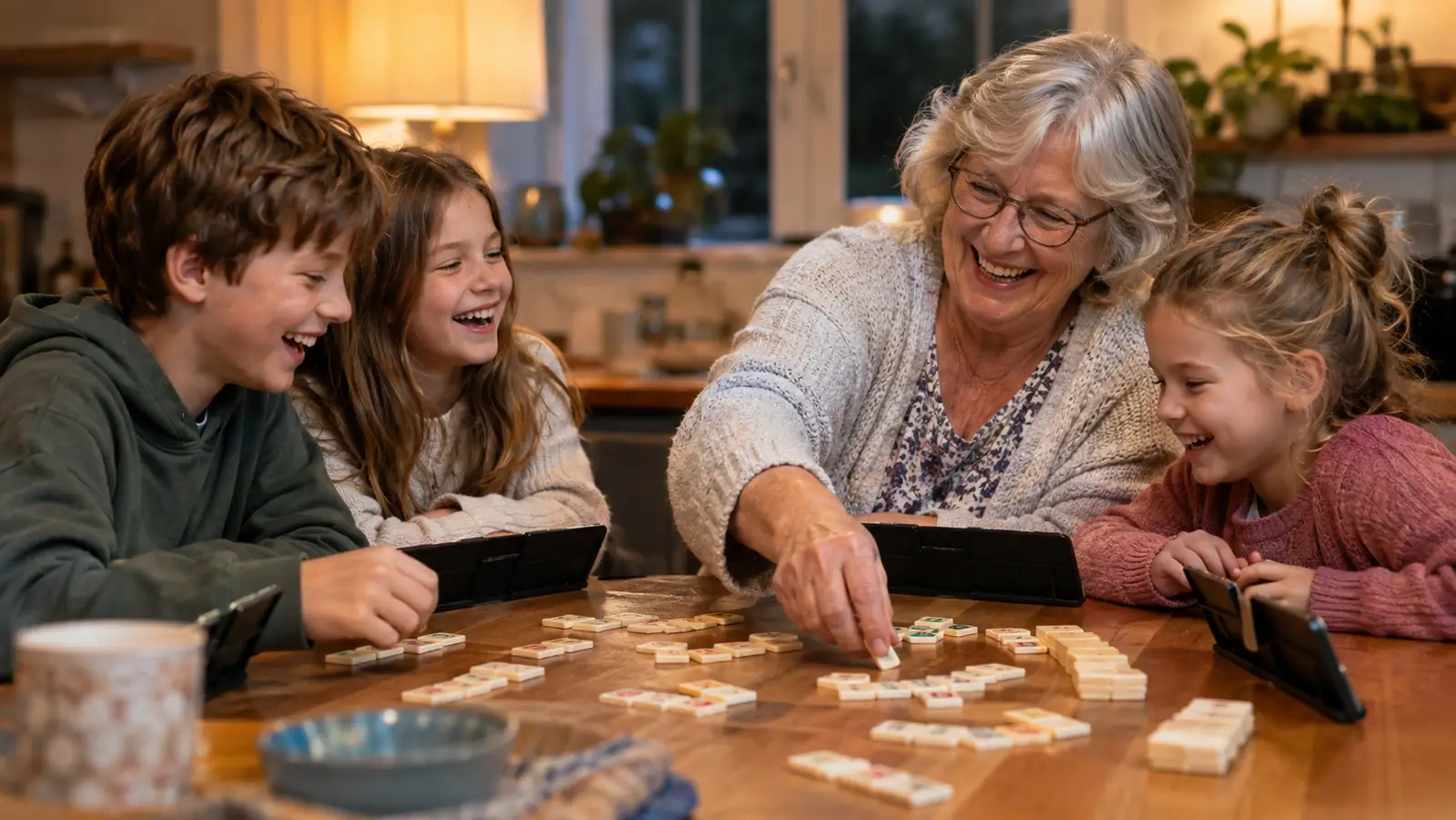
Here is what I would tell a friend before they bought it. The game plays best with two to four people, and the box is honest about that, but a full table of four has real downtime between turns. With three grandchildren and one grandmother, someone is always waiting. It has not been a problem in our house because the waiting players watch the board and plan, but a family that wants constant action will find the rhythm slower than a party game. The waiting is hardest for Rosie, who finishes her planning in about four seconds. She has learned to use the time by watching Eli's hand hover over the bag, trying to guess what he is fishing for. That is not a complaint, just a heads up for families with a very young player who struggles to sit still.
I timed our games one Sunday out of curiosity, the way I used to time reading groups at school. The shortest game was seventeen minutes, a two player game with Maya on a school night. The longest was forty-one minutes, a four player game where Eli traded tiles in six separate turns and still finished second. Most of our games land right around twenty-five minutes, which fits neatly between dinner and bedtime. The luck factor showed up most clearly in a game last month. I was holding three tiles that would complete a Qwirkle if I could draw one specific shape, and I drew the wrong tile seven turns in a row. Rosie won that game by nine points. I am not bitter. Mostly.
And the scorekeeping. The box includes a small paper pad and a pencil stub, and the pad runs out faster than you expect. We switched to a dry erase board early on, and keeping score has become part of the ritual. Small things, but they are the difference between a game that gets played and a game that sits on the shelf.
What I Liked
- Teaches in under two minutes, even to a six-year-old
- Real strategy appears as players improve, so it grows with the kids
- Wooden tiles hold up through fifty-plus games without chips or splits
- Works for two players or four, quiet games or loud ones
- Games run about twenty-five minutes, short enough for attention spans
Where It Falls Short
- The drawstring bag is too small; replace it early
- Downtime between turns can drag with four players
- Luck of the draw can decide close games
- The paper score pad runs out quickly
Eli laid down a single tile, completed two lines at once, and scored fourteen points in one move. He has not stopped talking about it since.
Who This Is For
Buy Qwirkle for the family that plays together across ages. Buy it for the house where a six-year-old and a twelve-year-old share a table and the adult in charge is tired of games that bore one of them. Buy it if you want a game a child can win honestly, because that moment changes how a kid feels about game night. It is also a strong pick for two adults who want a quiet, thinking game that fits in twenty minutes, and it travels well enough to come along on a visit to grandparents.
Who Should Skip It
Skip it if your group wants loud, fast, simultaneous fun, because the turn-based rhythm will feel slow. Skip it if you hate games decided by luck, because the draw can absolutely sink a well planned move. And skip it if you already own a tile game your family loves and plays regularly, because Qwirkle does the same job and you do not need two. For everyone else, it earns its place on the shelf.
The game our table keeps coming back to
Six months and more than fifty games later, Qwirkle is still the first game the kids ask for on Sunday nights. If that sounds like your table, check today's price on Amazon.
Amazon Check Today's Price on Amazon →