
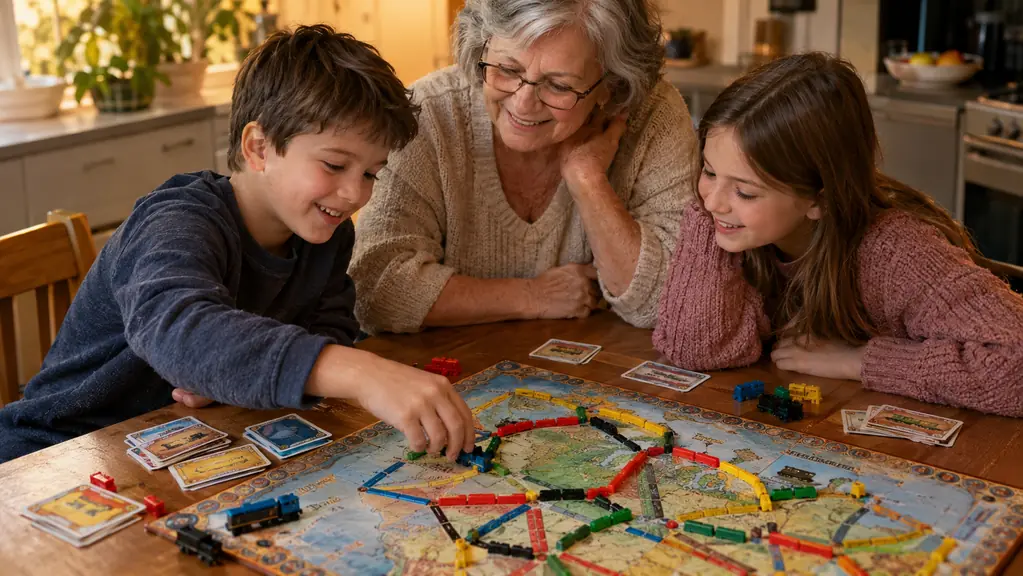
The first time I brought Ticket to Ride to our Sunday game night, I did everything backwards. I handed Rosie, who is six, the whole deck of destination tickets, explained every rule in one breath, and then watched her build a fence out of the little plastic trains instead of a route. If that sounds familiar, take heart. Every family I know has a story like this, and almost every one of them blames the game. The game was not the problem. The teaching was. I am June Hollister, and game night at our house has run every Sunday for years, with Maya at twelve, Eli at nine, and Rosie at six, plus my husband Frank when he can be talked into it. This is the sequence that finally worked at our oak kitchen table, and I believe it will work at yours.
Route-building games ask a child to hold a goal in their head, look at a shared map, and plan several moves ahead. That is a lot of separate skills, and most rulebooks teach them in the wrong order for a young kid. Ticket to Ride from Days of Wonder happens to be the gentlest way I have found to teach all of them, because the rules arrive one at a time if you let them. Here is how I taught it to three very different grandchildren, in the order that actually worked at our table.
The board game that taught a 6-year-old to plan a route
Ticket to Ride (2025 Refresh) from Days of Wonder is the version on our shelf. It has survived a year of Sunday nights with a six-year-old, and the box still closes flat. Check today's price on Amazon and have it ready for your next family game night.
Amazon Check Today's Price on Amazon →Step 1: Deal destination tickets face up and play one route only
The biggest mistake I made was treating destination tickets like the main event. They are not the main event for a young child. They are the payoff, and the payoff should come after the fun. So for the first game, deal three tickets to each player and lay them face up on the table where everyone can see them. No hiding. No hidden goals. Everyone reads their tickets out loud, even the adults, because hearing the goal spoken makes it real for a child who cannot read yet. Rosie cannot read the city names, so hearing me say them is how she knows what she is aiming for. The only job for the first game is to read where your tickets go and point at those cities on the map.
I did this with Rosie while the older two played a normal game nearby. Her tickets went from Los Angeles to Las Vegas, and from Denver to El Paso. She needed help reading the names, so I read them aloud and let her trace each route with her finger. That single change, tickets face up, turned a pile of rules into a question she actually wanted to answer: how do I get there?
Keep the first game to one destination ticket per player. The point is not to play Ticket to Ride correctly. The point is to let a child experience the satisfaction of claiming a route and watching their little trains appear on the map. That feeling is what carries them through the harder rules later. If you try to teach everything at once, you lose that feeling, and the game night turns into a lecture. Nobody wants that.
Step 2: Let them own their trains before they learn the card matching
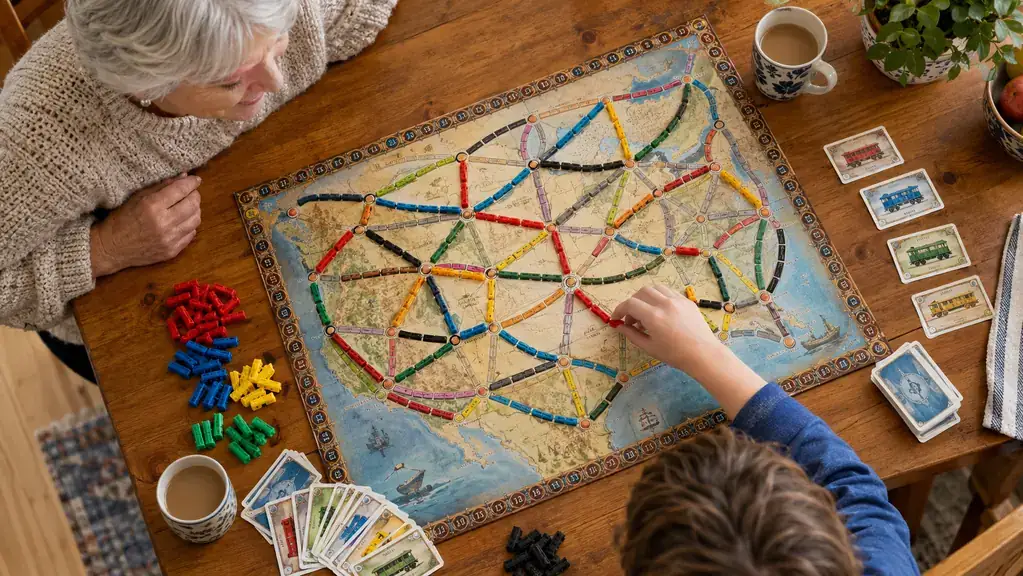
Ticket to Ride is a card game wearing a train game costume. You collect cards, and you spend matching sets to claim routes. For a six-year-old, the card part is the hardest part. So before we ever talked about matching colors and sets, I let each kid pick their train color and guard their own bag of pieces. Rosie guarded hers like a dragon. Eli lined his up in a row. Maya counted hers twice and declared the total correct.
The ownership matters more than it sounds like. When a child feels the trains are theirs, they want to see them on the board. I handed out snack baggies from the kitchen drawer so nobody mixed up their pieces, and I wrote each name on a bag with a marker, Maya on one, Eli on another, Rosie on the third. I told each kid their only job was to keep the bag safe until the first route was claimed. That gave the younger two something to do while the adults dealt cards and explained turns. It also gave them a stake in the game before they understood a single rule.
Only after the trains felt like theirs did I introduce the card matching. I showed Rosie that a route between two cities needs cards of one color, and that the number of cars on the route tells you how many cards you need. We counted together: a route with three cars needs three cards. She did not fully get it until the fourth game, and that was fine. The trains were already hers, so she had a reason to care about the cards.
Step 3: Play one shared route so they see the whole loop
The fastest way to teach the full turn loop is to build one route together before anyone builds their own. I cleared a corner of the board, picked a short route between two close cities, and walked through the loop out loud: draw two train cards, then decide if you have enough to claim a route. Claim it, put your trains down, draw three new cards. The whole thing takes ninety seconds, and a child can see the beginning and the end of a turn in one sitting.
I did this with each grandchild one at a time while the others watched, which meant the older two got a refresher and Rosie got a demo she could actually follow. The key was saying the loop the same way every single time. We still say it at our table: 'draw, match, claim, restock.' When a child can say the loop back to you, they are ready to play a real turn by themselves.
Do not let the demo turn into a lecture. The second I caught myself explaining long routes and ticket strategy, I stopped and handed the cards over. Kids learn the loop by doing it, not by hearing it. If you feel the urge to explain more, pass them the trains and let them try. The demo is done the moment they reach for the pieces.
Step 4: Add destination tickets for real, and do not block a kid's first routes
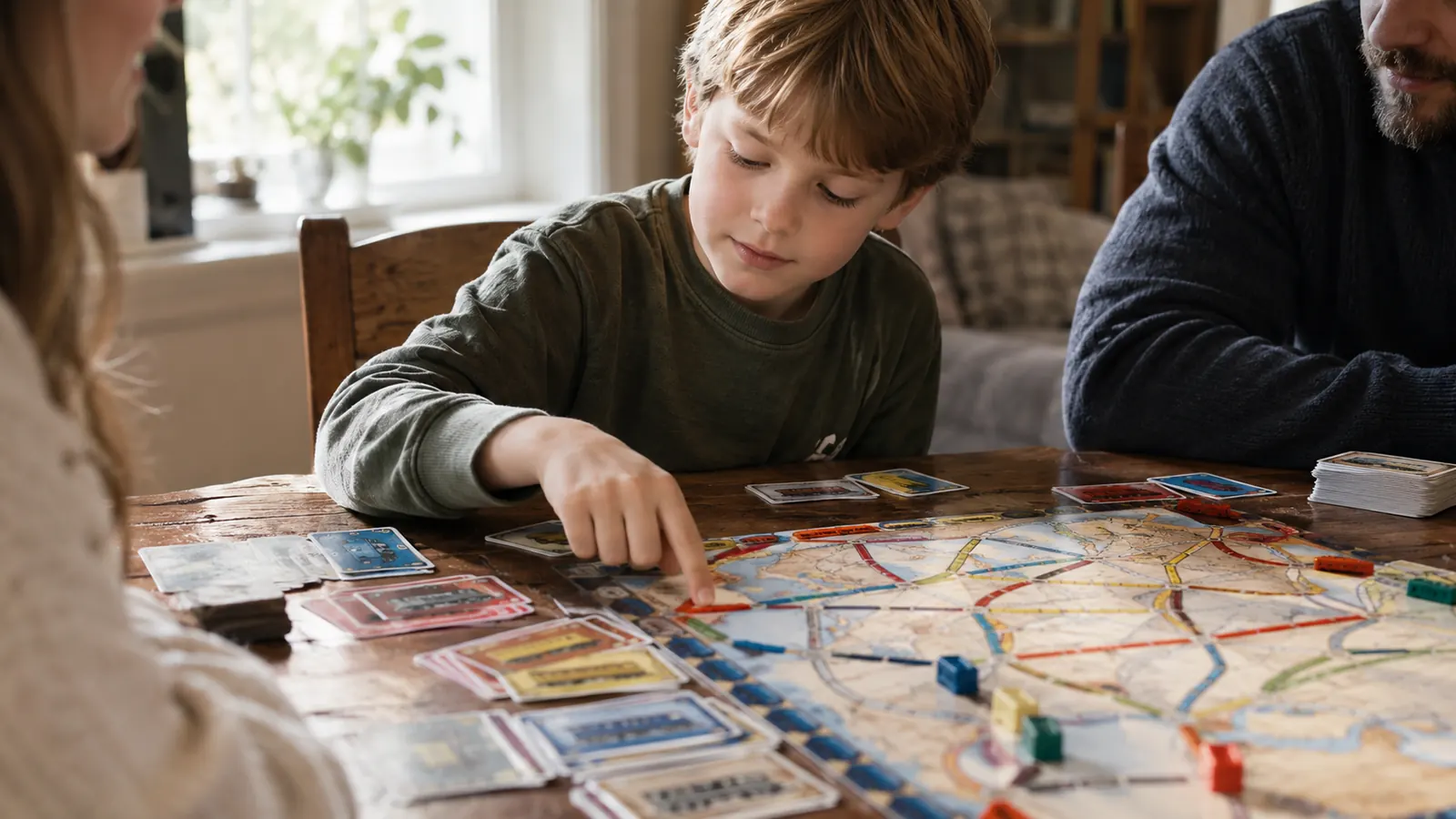
Once the loop is comfortable, introduce real destination tickets and the moment the game becomes a game. I dealt three tickets to each player, told everyone to keep at least two, and then made a rule for myself: I would not claim a route that a kid was clearly heading for. That rule lasted exactly one game. It mattered, though, because it gave Eli the space to finish his first real route without an adult snatching the path out from under him.
Eli is my planner. He decided to build from Chicago to New Orleans, a chain of three routes that took him most of the game, and he watched me the whole time to make sure I was not taking his cities. When he claimed the final route and connected the two ends, he sat back with a look I have not forgotten. He had held a goal in his head for twenty minutes and reached it. That is the whole skill of route-building, and he got it by playing, not by being taught.
Here is the honest part. The first time I blocked Eli's route in a later game, he was upset for a full minute. Then he started studying the board before choosing his next ticket, which is exactly what the game is supposed to teach. Blocking is a lesson, but only after a child has won a few routes without interference. Let them taste success first. The competition can wait until they ask for it.
Step 5: Play the full game and let the scoring arrive on its own
The full game of Ticket to Ride adds hidden tickets, the longest route bonus, and the small panic of watching someone take a route you were saving. For a kid, that is a lot. I introduced the scoring one piece at a time. The first full game we played, I announced the longest route bonus and quietly skipped the rule that you must keep two tickets. She did not need to know the rule existed yet. Maya kept all three because she could. Rosie kept one and was thrilled with her choice.
Let kids score their own routes. Counting points is arithmetic practice wearing a game costume, and my years as a school librarian tell me that practice disguised as fun is the only kind that sticks. We counted Rosie's points out loud, one route at a time, and she announced the total like she had won the lottery. She had not won. She had scored twelve points in a game where Maya finished well ahead. It did not matter. The number was hers.
Rosie won her first full game three months after we started, and she won it the way a six-year-old should: by building short routes along the East Coast while the rest of us fought over the long western lines. She did not know she was playing smart. She just knew her little trains filled up the board faster than anyone else's. That is the moment I want every family to see. The scoring can wait. The joy of watching your own route grow is the real lesson.
What Else Helps
A few practical things made the difference at our house. First, the board is big. It covers most of our oak table, so I clear the whole surface before we deal. Second, small hands struggle with a big fan of cards. I bought a cheap card holder, the kind meant for poker, and Rosie holds her train cards in it. I found it at a thrift store, and it was the best small purchase I have made for game night. It sounds silly, and it cut her frustration in half. Third, we keep each color's trains in its own snack bag between games, so setup takes five minutes instead of fifteen.
Start with two players before you attempt the full table. My best teaching games were one grandkid and me, with Frank making popcorn and the other two doing homework. A one-on-one game moves fast, the child gets a turn every few minutes, and you can narrate your own choices without a crowd listening in. After two or three of those, the full table of five works fine, and Sunday night feels like a real event again.
Finally, remember what the box from Days of Wonder actually promises: a train adventure for ages eight and up. Rosie is six and she plays with help, and that is okay. The age on the box is a suggestion, not a verdict. If your six-year-old only builds a fence for the first game, that is still a successful game night. The route-building will come when they are ready for it, and the best thing you can do is let them take their time.
The moment it clicked for Rosie was not a big win. It was a two-car route from Montreal to Boston, two whole points, that she planned all by herself, and she talked about it for a week.
Give route-building a fair shake at your kitchen table
Ticket to Ride from Days of Wonder is the game that taught my grandchildren to plan ahead without a single lecture. Check today's price on Amazon and bring it to your next game night.
Amazon Check Today's Price on Amazon →