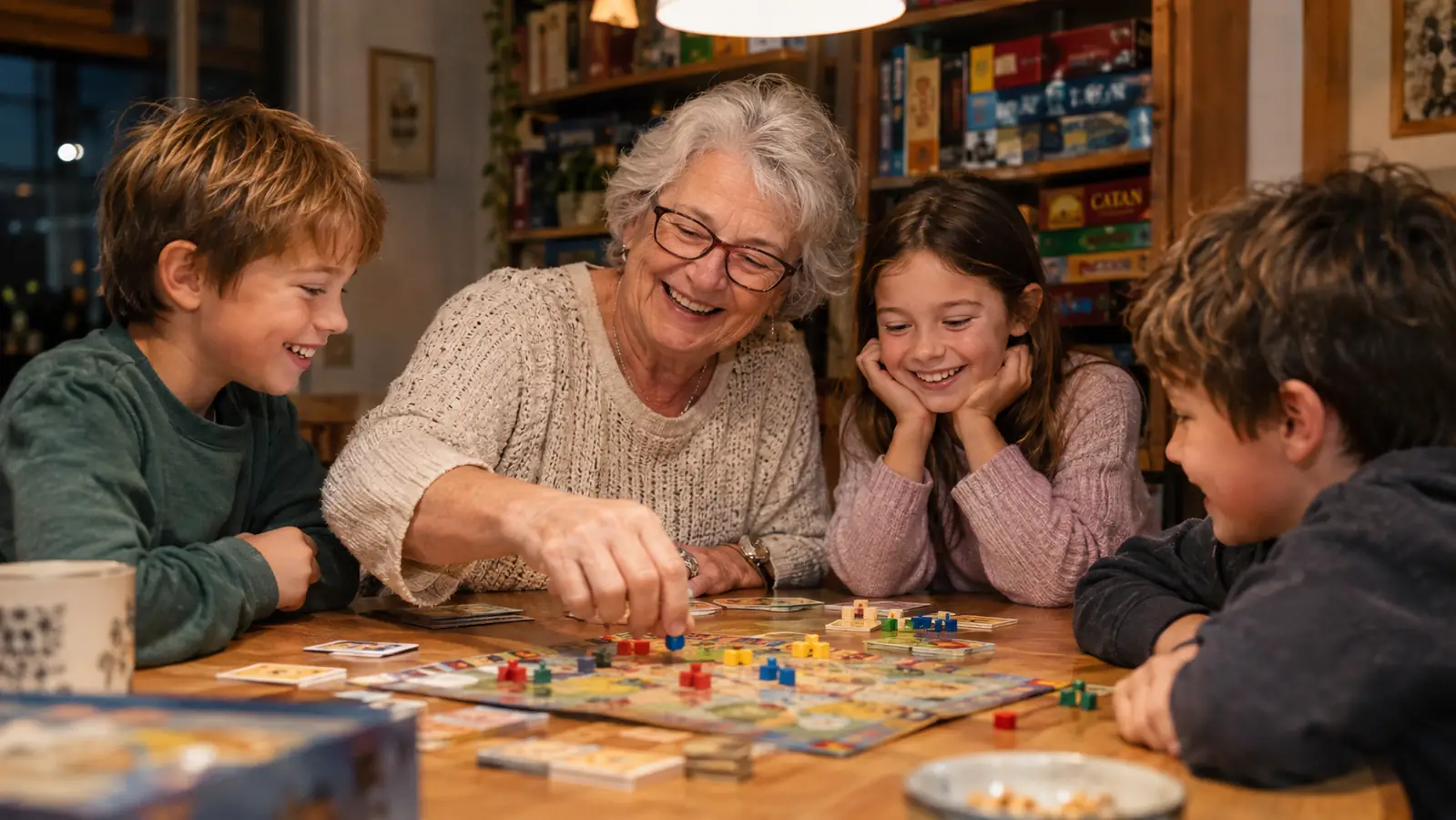
The first Sunday we played Peaceable Kingdom's Hoot Owl Hoot, I made a mistake that taught me more about the game than any rulebook could. I assumed my six-year-old granddaughter Rosie would need the most help, my nine-year-old grandson Eli would get bored, and my twelve-year-old Maya would check out entirely. All three assumptions were wrong within ten minutes.
Let me set the scene. It's a Sunday evening in October, the oak kitchen table is set for game night, and the games are freshly pulled from the bookshelf in the den. Rosie is bouncing in her chair, Eli is reading the box like it's a treasure map, and Maya is pretending she's too old for this. By the time the sun card moved the sun to the nest and all six owls made it home, Maya was the one asking to play again. That's when I knew this game was different.
The Quick Verdict
A cooperative matching game that keeps a six-year-old engaged, a nine-year-old invested, and a twelve-year-old asking for another round. It earned its spot on our shelf in a single night.
Amazon Check Today's Price →The Game That Gets Three Different Ages to the Same Table
If you're tired of games where the youngest player ends up in tears and the oldest player ends up bored, Hoot Owl Hoot is worth a look. We've played it for a full season of Sunday game nights, and it's still the first box Rosie reaches for.
Amazon Check Today's Price on Amazon →How I've Used It
I've been hosting Sunday game night at my house in Bakersfield for about a year now. I'm the grandmother with the full bookshelf of games, which means I'm also the one who reads every rulebook cover to cover before the kids arrive. When Hoot Owl Hoot arrived in early October, I read the instructions twice, set up the board on the kitchen table, and ran a practice round by myself like a slightly ridiculous adult playing solitaire with owl tokens. One thing I tried first that failed: I let Rosie shuffle the deck on our second night. She is six, and her shuffle is more of a dramatic toss. Cards went everywhere, including behind the bookshelf, and we spent ten minutes fishing them out. Frank suggested a simple rule after that: the oldest player shuffles, the youngest player cuts the deck. It sounds small, but it saved the game for us.
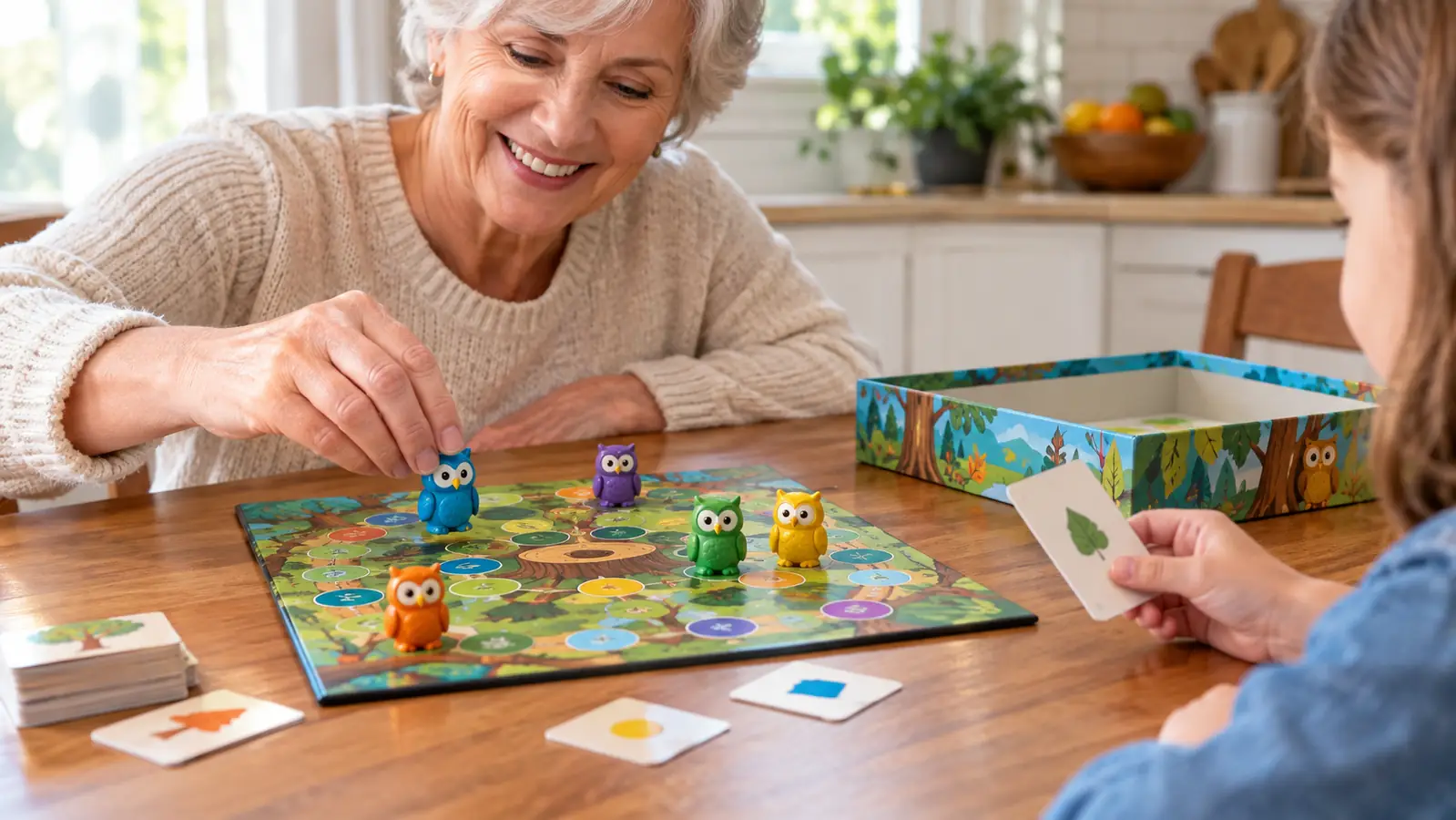
The setup is simple. The board shows a path of color-coded spaces leading from the forest to the nest, and six owl tokens start at the beginning. On your turn you flip a card: if it shows a color, any player moves any owl to the next space of that color. If it shows a sun, the sun moves one step closer to the nest. The catch is the whole table wins together, or the whole table loses together, and if the sun reaches the nest before all six owls do, everyone loses. The rulebook suggests starting with three owls for younger players and adding more as they get the hang of it.
We started with the full six owls on night one because Rosie insisted, and we lost. She didn't cry. She didn't blame anyone. She said 'we have to try again' and reset the board herself. That moment told me more about the game's design than any review I'd read. In a competitive game, a loss means someone is the loser. In Hoot Owl Hoot, a loss means the table lost together, and my six-year-old handled that far better than I expected. The other adjustment came on Thanksgiving week, when we had six people at the table for the first time. With Frank playing, the game took on a different energy. He is not a natural board game guy, but he got competitive about the sun. He started counting moves out loud, and Rosie started copying him. By the end of the round, all six of us were counting together. I made a note of that date: the first time Frank asked to play again without being talked into it.
Why a Cooperative Game Earned a Spot on Our Shelf
The short version: I grew up on video games with my own kids in the nineties, so I have a soft spot for games with actual strategy and replay value. When my daughter suggested a cooperative game for the grandkids, I was skeptical. Cooperative games for young children can be thin, the kind where the 'game' is really just a lesson wearing a costume. Hoot Owl Hoot is not that.
The decision-making is real. The color cards are random, but choosing which owl to move is not. Do you move the owl closest to the nest to secure an early win, or the owl farthest behind to spread your risk? When the sun is three spaces from the nest and three owls are still in the woods, every move matters. I watched my twelve-year-old Maya start quarterbacking the table by week three, and honestly, that's part of why it works. The game gives older kids a role that doesn't involve carrying the younger ones.
It also plays in about fifteen minutes, which is the single most important number for a game night with a six-year-old. Fifteen minutes is short enough that a loss doesn't sting and long enough that a win feels earned. We played four rounds in a row one Sunday and nobody asked for a screen, which is about the highest compliment a game can get in this house.
I'll be honest about what I expected, because it matters. I grew up on video games in the nineties, games where you could lose a level twenty times and the game kept score. I respect a game with a learning curve and a payoff. My worry with a cooperative kids' game was that it would be all payoff and no curve, the kind of thing a child masters in one sitting and never touches again. Hoot Owl Hoot has a curve, it's just a social one. The first few rounds, the kids each moved whichever owl was closest without thinking. By December, they were arguing, politely, about which owl to move and why. Watching a six-year-old make a case for one owl over another because the sun was two spaces away, that is a real decision, made under real pressure, and it happens in fifteen minutes.
How It Actually Plays With a Six, Nine, and Twelve Year Old
The real test of any family game is whether three very different ages can play it at the same table without someone checking out. Rosie, at six, loves the ritual of flipping the cards and moving the owls. She does not fully grasp the strategy yet, and she doesn't need to. Eli, at nine, has started planning two moves ahead, which is exactly the kind of thinking I want him practicing without realizing he's practicing it.
Maya was my worry. Twelve-year-olds can smell a baby game from across the room. But Hoot Owl Hoot gives her something competitive games don't: a chance to be genuinely useful. When the sun is closing in and three owls are still in the woods, the table needs someone to think. Maya became that someone. One Sunday in November, she talked Rosie through a move without taking over, and I nearly cried into my tea.
A similar moment came in early January. Eli and Maya disagreed about a move. Maya wanted to bring the trailing owl forward, and Eli wanted to finish the owl closest to the nest. Rosie sat between them, watching like a referee. After a full minute of back and forth, Eli turned to Rosie and asked what she thought. Rosie pointed at the trailing owl, Maya shrugged, and they moved it. Nobody won or lost that argument in the usual sense. The game just went on, and the whole table was better for it. That is not something I have seen happen with a competitive game at this table, and it is the reason I keep putting this box on the shelf where little hands can reach it.
The one thing I'll flag is the luck factor. The cards can gang up on you. We lost three games in a row one evening in December, and even I started to wonder if the deck was rigged. Then we won the fourth by a single move, and Rosie leaped out of her chair. The swings are real, and the close wins are what the kids remember. The rulebook also offers a difficulty dial, which I appreciate more every time we use it. For younger kids, you play with fewer owls. For older kids, you add more. We've settled on five owls as our family's sweet spot: hard enough that Maya and Eli feel the tension, easy enough that Rosie stays in the game.
Component Quality and the Fifty-Play Test
I judge a kids' game by whether the box survives a season of Sunday nights, and this one has held up. The board is thick and lays flat on the oak table. The cards are sturdy enough that Rosie's enthusiastic shuffling hasn't bent them. The owl tokens are solid plastic pieces that fit small hands and don't slide around the board when somebody gets excited.
The box itself is the one weak spot. After about fifty plays, the corners are starting to show wear, and the insert inside doesn't hold the pieces as snugly as I'd like. The one real scare came in December, when Eli knocked the box off the shelf while reaching for a different game. The lid popped open, and I braced for pieces everywhere. The insert held, the cards stayed in their pouch, and only one owl token rolled under the table. Nothing is broken, and the box still closes properly. For a game that gets played this often, that's the durability test that matters.
One thing that surprised me: Peaceable Kingdom writes its rules in plain language. There's no twenty-page manual, no symbol glossary, no way to misread a rule. I read it once and taught it to Frank in about two minutes, which is a record for our house.
Storage is worth a mention, because it affects how often the game actually gets played. The box is the right size for the bookshelf in the den, not so big that it topples the row, not so small that it gets lost behind the card games. We keep the cards in a small cloth pouch I added, which was my one modification after the great card spill of October. The owl tokens stay in the insert, and the board folds flat. Setup takes about ninety seconds, which is the other half of why this game gets chosen. A game that takes ten minutes to set up does not get played on a school night. A game that takes ninety seconds does.
What It Teaches Without Feeling Like a Lesson
The cooperative design does something clever in the best way: it teaches turn-taking, patience, and shared decision-making without any of it feeling like a lecture. Rosie has learned to wait for her turn because waiting is part of the team's plan, not because an adult told her to. Eli has learned that talking through a move with the table beats making a move in a vacuum.
I also like that losing together is a lesson in itself. In a competitive game, someone has to be the bad guy. In Hoot Owl Hoot, the sun is the bad guy, and it's not personal. When we lose, the kids immediately want to try again, which is the healthiest relationship with losing I've seen at this table. My own kids played plenty of video games in the nineties, so I know how valuable that is.
If you want the full philosophy, I've written about why cooperative games work so well for young kids in a separate article. And if you're trying to decide between this and Candy Land, I've compared them head to head. The short version: Candy Land is pure chance, and Hoot Owl Hoot gives even a six-year-old a real choice to make.
What I Liked
- True cooperative play: the whole table wins or loses together
- Fifteen-minute rounds that fit a young child's attention span
- Difficulty dial lets you add or remove owls to match the players
- Sturdy cards and tokens that survive a season of heavy use
- Gives older kids a real strategic role instead of a babysitting job
Where It Falls Short
- Luck of the draw can create frustrating losing streaks
- Box corners and insert show wear after fifty plays
- Light strategy means older kids will outgrow it eventually
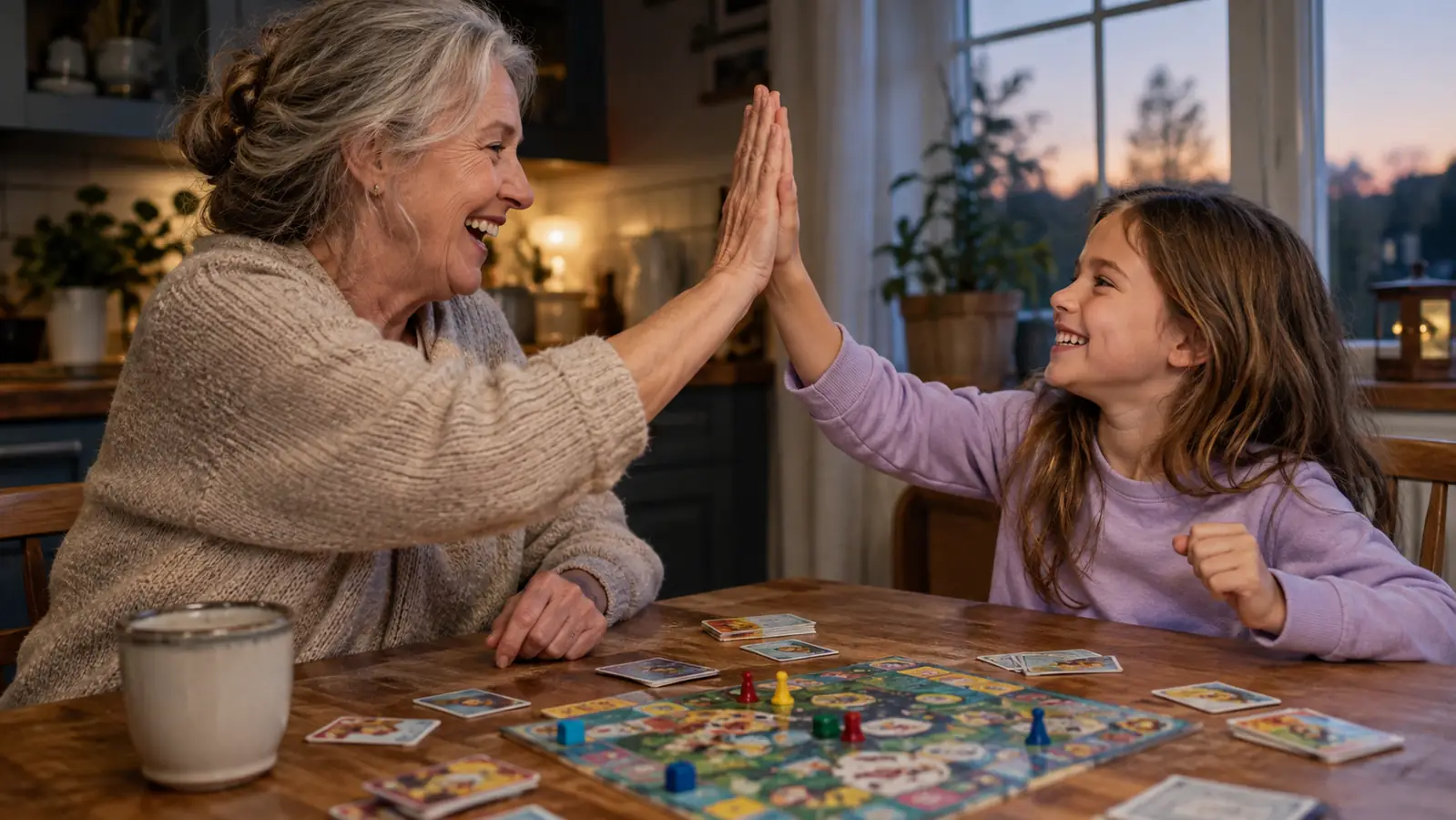
We lost three games in a row one December evening, then won the fourth by a single move, and Rosie was out of her chair before the last owl landed.
Who This Is For
Hoot Owl Hoot is for families with a mix of ages, especially if the youngest player is between four and six. It's also for grandparents like me who want a game that doesn't end in tears. If you host a weekly game night like we do, this is the game that bridges the gap between the preschooler and the preteen. Peaceable Kingdom makes a handful of cooperative games, and this is the one that fits our table best. It's the first box Rosie reaches for every Sunday, and after a full season of plays, it's still the one I'm happiest to see her grab. I told the full story of how it became our Sunday tradition in a separate piece, if you want the long version.
Who Should Skip It
If your kids are all eight or older, this will likely feel too simple. The strategy is real but light, and older kids who want depth will exhaust it in an afternoon. If you're looking for a game that can grow with a child from preschool into middle school, you'll want something with more layers. And if you prefer competitive games, where every player fights for their own win, the whole premise will feel strange. There's no individual winner in Hoot Owl Hoot, and that's the point, but it's not everyone's point. It took Frank a few rounds to stop treating the other players as opponents. By round three, he was rooting for the owls like they were his team. I'd still say try it once before you decide it's not for your house.
Give Your Next Family Game Night a Game Everyone Roots For
A full season of Sunday nights says this one works. If you're shopping for a game the whole table can play together, Peaceable Kingdom's Hoot Owl Hoot is the box I'd put in front of a six-year-old first.
Amazon Check Today's Price on Amazon →