

Sunday game night at our house has one rule: everybody plays, even the people who swear they are not board game people. So when the debate came up between Gamewright's Forbidden Desert and Pandemic, I did what I always do. I read both rulebooks cover to cover before the grandkids arrived, then I ran both games for two weeks at our oak table. Maya is twelve, Eli is nine, Rosie is six, and Frank only plays when the game is worth being talked into. That is the exact table this comparison is written for, and it is probably close to yours.
Here is the short answer. If you want a cooperative game a six-year-old can genuinely play, that sets up in under five minutes, and that usually ends with high fives instead of a table flip, buy Forbidden Desert. If you want a tense, think-hard strategy game where losing stings and winning feels earned, buy Pandemic. Both are excellent. They are just different evenings, and I would rather you buy the one your table will actually play.
| Forbidden Desert | Pandemic | |
|---|---|---|
| Play time | About 45 minutes, short enough to finish before bedtime | Closer to an hour, and most groups run long |
| Age range | Box says 10+, but a coached six-year-old can hold a real role | Box says 8+, the lower starting point on paper |
| Players | 2 to 5 players, so a guest can squeeze in | 2 to 4 players, a tighter table |
| Setup | Deal roles, shuffle one deck, stack the tiles | Sort the disease cubes, shuffle four decks, place the cities |
| Difficulty | Challenging but forgiving; one bad turn rarely ends the game | Brutal; outbreaks chain and the board can spiral |
| Strategy depth | Clever storm mechanics, but the right move is usually clear | Every turn is a trade-off and the group will debate |
| Replay value | Random tile layout keeps it fresh for a good while | More roles, expansions, and a legacy version keep it alive for years |
| Price | Usually the more affordable pick on Amazon | Typically costs more, and the expansions add up |
| Best for | A relaxed family table that wants to win most nights | A group that enjoys a punishing challenge and a post-game autopsy |
How I Tested Both at Our Table
I ran both games across three Sunday game nights, plus two weekday afternoons when Rosie asked for the desert one by name. Forbidden Desert got played at two, three, four, and five players. Pandemic got played at three and four, and one time we bent the player count to let Eli's friend join, which the box warns against, so I am not counting that session as a fair test. Every game got the same house rules: I read the rules aloud, nobody was allowed to quarterback, and the loser helped clear the table.
I also judged both games by the questions I actually care about. Can a six-year-old hold a real role without being told what to do every turn? Can a twelve-year-old stay locked in for the whole game? Does Frank wander off halfway through? Does the game still feel good on the tenth play? That last question matters more to me than any rulebook promise, because a game that gets played once a year is just an expensive box.
I kept notes the way I used to keep reading logs at the library. Which roles did the kids grab first? Who drifted off mid-game? Did anybody ask to play again the next day? Those notes told me more than any rating. Gamewright's Forbidden Desert holds a 4.8 average from more than 3,800 Amazon ratings, and Pandemic deserves its own excellent reputation, but a rating cannot tell you whether your six-year-old will stay engaged. Only a real game night can do that.
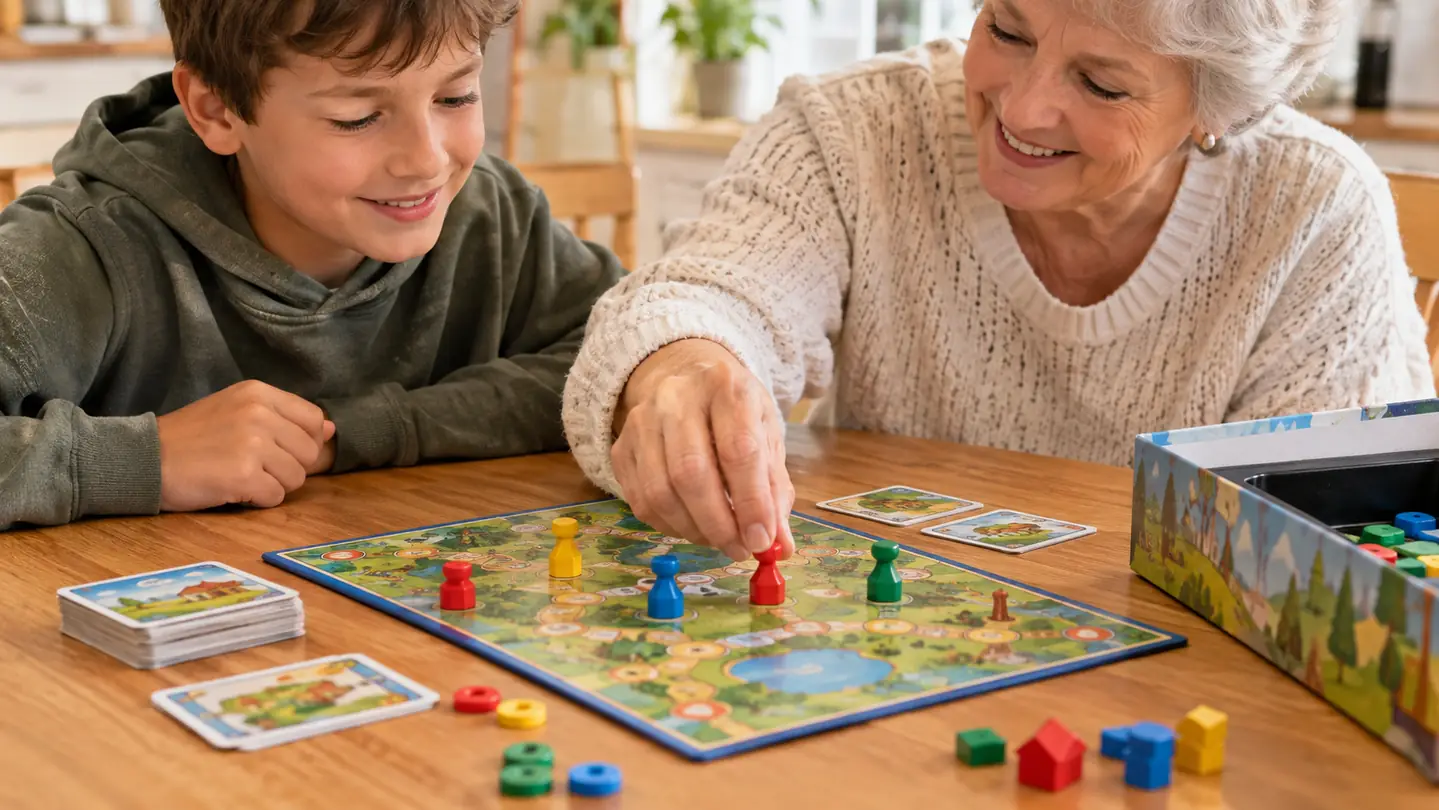
Where Forbidden Desert Wins
Gamewright's Forbidden Desert wins the night for most families because it forgives mistakes. The storm moves the tiles around the board, which sounds cruel, but it also means the map changes every turn and no single bad decision ends the game. When the group loses, you usually see it coming, and the failure is gentle. You run out of water, the storm covers the board, and everybody shrugs and sets up again. Rosie lost twice in a row and asked to play again both times. That does not happen with Pandemic.
The water mechanic is the detail I want to call out. In Forbidden Desert, the whole group shares one water supply, and when the water runs low, everybody feels it. That forces cooperation in a way that Pandemic does not quite match, because in Pandemic a player can quietly play her own game while the team slowly loses. Sharing water means nobody gets to check out. The group wins together or the group runs dry together, and for teaching kids what cooperation actually means, that is gold.
It also wins on logistics, and logistics are half of family game night. Setup takes about four minutes: deal the roles, shuffle the deck, stack the desert tiles. A full game runs about forty-five minutes, short enough to finish before Rosie's bedtime even when we start late. And it supports five players out of the box, so when Eli brings a friend, nobody sits out. For a kitchen table that seats six and a family that includes a six-year-old, those three things, quick setup, short play time, and room for five, are the difference between a game that lives on the shelf and a game that actually gets played.
Where Pandemic Wins
Pandemic wins the argument about depth, and I say that as somebody who genuinely loves Forbidden Desert. Every turn in Pandemic is a real trade-off. Do you treat the outbreak in Asia or move toward a cure? Do you use the Medic's ability now or save it for the next epidemic? The infection deck punishes hesitation, and the epidemics shuffle into the player deck without warning, which means the whole game can turn on a single draw. Maya loved that tension. She sat forward for the whole hour, and after we lost, she wanted to talk through our decisions for another thirty minutes. That is not a flaw. That is a feature, if your table wants it.
Pandemic also wins on replay value if you are the kind of group that plays one game fifty times. The role combinations change the puzzle, the expansions add real mechanics, and the legacy version turns the whole thing into a campaign you play for months. Forbidden Desert stays fresh for a long time because the tile layout is random every game, but it does not have Pandemic's long tail. If you want one game that can grow with a serious game group for years, Pandemic is the one. Just know that it asks more from every player at the table.
What About Expansions?
Pandemic has a mountain of expansions, and that is part of its appeal. On the Brink adds new challenges, In the Lab changes the way cures work, and the legacy games turn the box into a story you write over a dozen sessions. If you are the kind of player who loves a game that keeps growing, that library is a real reason to pick Pandemic. Forbidden Desert is part of a series that includes Forbidden Island, Forbidden Sky, and Forbidden Jungle, but the desert game itself has no expansion, and it does not need one.
For our table, that is a point in Forbidden Desert's favor. I do not want to buy six expansions to keep a game interesting. I want one box that I can pull off the shelf on a Sunday afternoon and play without relearning anything. Forbidden Desert is that box. Pandemic is a hobby. Forbidden Desert is a game night.

The One Thing Nobody Tells You
Nobody tells you that the real difference between these two games is how often the table wins. Forbidden Desert is tuned to be beatable. Our group won about half our sessions, and the losses were close enough that everybody wanted a rematch. Pandemic is tuned to be brutal. We lost our first four games in a row, and one of those losses came down to a single card draw that made Eli groan out loud. Some families love that. My table includes a six-year-old, and Rosie does not understand why a game would work so hard to beat her.
Here is another thing nobody tells you: the quarterback problem. In every cooperative game, one strong player can end up telling everybody what to do, and that is the fastest way to make the quiet players check out. Pandemic makes this worse because the right move is often genuinely hard to see, so the strongest player takes over. Forbidden Desert has the same risk, but the storm is chaotic enough that even the best player cannot control everything, which forces everybody to contribute. For a mixed-age table, that is a quiet kind of magic.
Forty-five minutes, five players, and a six-year-old who asks for the desert one by name. That is the whole case for Forbidden Desert at a family table.
The Rulebook Test
I read both rulebooks cover to cover, which is my version of a spa day. Gamewright's Forbidden Desert rulebook is short, plain, and full of examples. It explains the storm meter, the water level, and the flying machine pieces in about ten minutes of reading, and the role cards do the rest of the work. I handed the rulebook to Eli and he taught the game to a visiting friend without any help from me. That is the highest compliment I can give a rulebook.
Pandemic's rulebook is clear too, but it is longer, and the game underneath it is harder to explain. The infection phase, the epidemic cards, the way outbreaks chain across cities, it took two full games before Rosie stopped asking why the cubes were multiplying. That is not a criticism of the game. It is a warning about who sits at your table. If everybody is nine or older and patient, Pandemic is fine. If you have a six-year-old who wants to feel useful on her very first turn, Forbidden Desert gets you to the fun faster.
For family game night, Forbidden Desert gets my vote
It sets up in minutes, plays five, and lets a six-year-old actually play. Check today's price on Amazon and see if it earns a spot on your shelf.
Amazon Check Today's Price on Amazon →Who Should Buy Which
Buy Gamewright's Forbidden Desert if your table looks like mine: mixed ages, mixed attention spans, and a game night that needs to end by eight. It is the game I reach for when Rosie is still awake, when Frank needs convincing, and when I want a cooperative win without a post-game autopsy. It is also the better gift for a family that has never owned a cooperative game, because the first session will probably end with everybody laughing and asking for another round. If you want the deeper tour of how it holds up over months of Sunday game nights, my long-term review walks through every part of the box.
Buy Pandemic if your group is all older kids or adults, if you enjoy losing and learning from the loss, and if you want a game you are still exploring a hundred plays later. It is the better purchase for a serious game group, and it is the one I would put in front of teenagers who think board games are for little kids. Just know what you are signing up for. Pandemic is a workout. Forbidden Desert is a night at the table. And for more on why cooperative games keep winning our family nights, our roundup of ten reasons is a good place to start.
And one more thing: buy the game you will actually play this month, not the game you think you should like. Our shelf is full of well-reviewed games that gather dust because they ask too much of a Tuesday night. The best board game in the world is the one that makes it back to the table. For us, that has been Forbidden Desert more weeks than not.
Still torn? Let your table decide
Both are fine games. Only one of them gets played every month at our house. Check today's price on Amazon for Forbidden Desert and see which one your family reaches for.
Amazon Check Today's Price on Amazon →