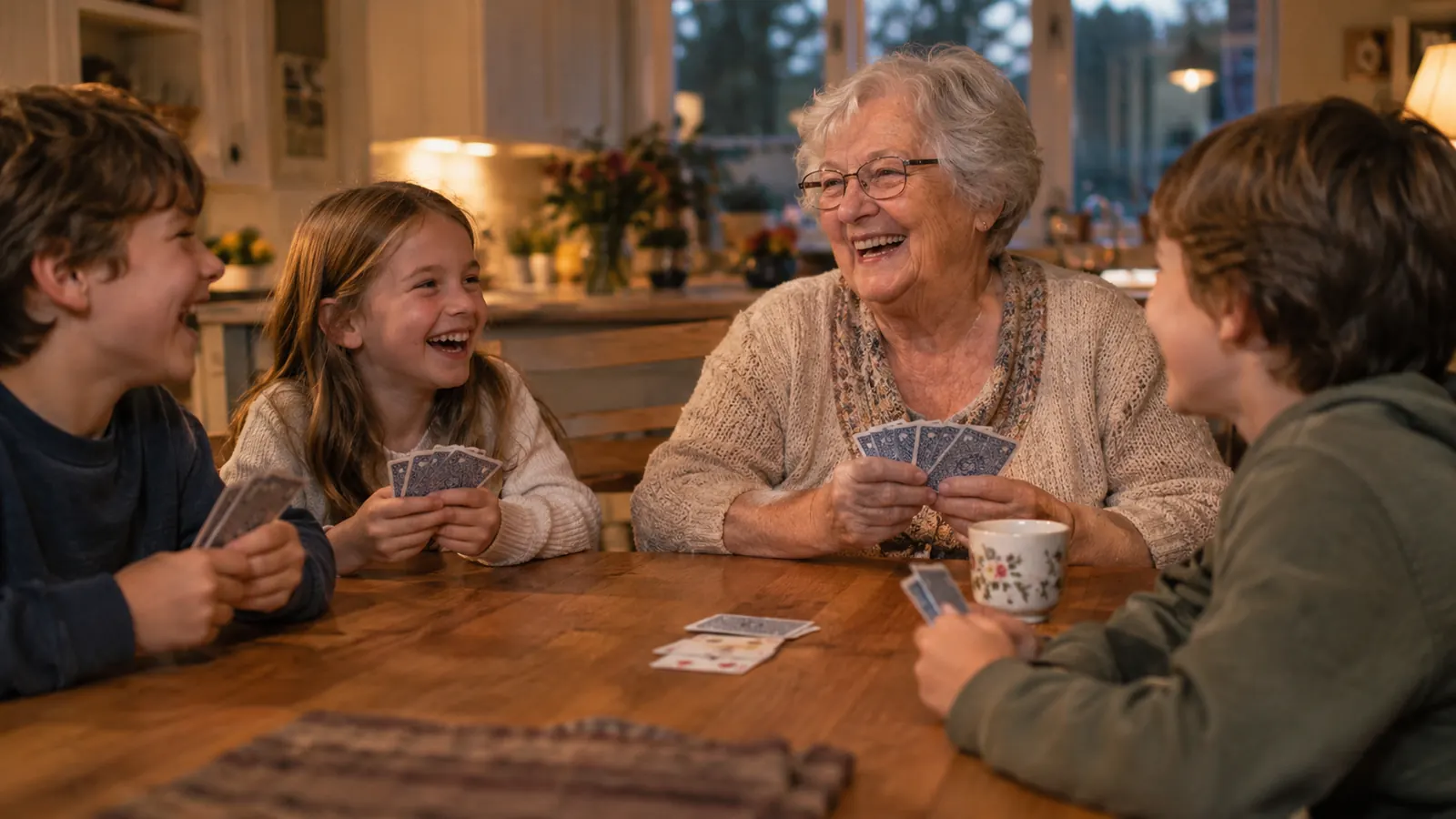
Sunday game night at my house has a rule: I read the rulebook before anyone arrives. So when Maya walked in one September Sunday with a box of Exploding Kittens and announced that her friend's family played it every single weekend, I did what I always do. I read the rules cover to cover, then I read them again, and then I set the box on the oak table with real doubts. A card game about a cartoon kitten that explodes sounded like a joke that had gotten out of hand, the kind of thing that sells on a trend and gets donated by Thanksgiving. By the fourth Sunday, I was the one shuffling the deck before anyone asked. That is how this review happened: not from one game, but from eight months of them.
This is the honest version. Not the one that tells you every game is a winner and every family will love it. I have run game night at this table for three years, and I have watched plenty of trendy games get played twice and then sit on the den bookshelf until I donate them. Exploding Kittens has been in regular rotation for eight months, so I have thoughts about what the marketing does not tell you, what the rulebook does not prepare you for, and who should actually buy it. If you are on the fence, this is the review I wish I had read before I bought the box.
The Quick Verdict
A fast, funny card game that earns its popularity, with sharp edges: luck can outweigh strategy, and someone always sits out every round. For a mixed-age family table, it is still the best game we added this year.
Amazon Check Today's Price →The Game My Grandkids Ask For by Name
Eight months after it arrived, Exploding Kittens is still the first box Maya reaches for on Sunday night. If you are tired of games that fizzle after one play, this one has earned its place at our table.
Amazon Check Today's Price on Amazon →How I've Used It (and How Our First Night Went Wrong)
We have played Exploding Kittens most Sunday nights since September, plus a handful of weekday evenings when Eli finishes his homework early and asks if we can do 'the kitten game.' Our oak table seats six and we are usually five: me, Frank when I can talk him into it, Maya at twelve, Eli at nine, and Rosie at six. The box says ages seven and up and two to five players, and both of those numbers turned out to matter more than I expected.
The first night was a mess, and the game was not the problem. I taught it the way the rulebook suggests, dealing seven cards to everyone and explaining each one as we went. Rosie lost interest halfway through the explanation, Maya kept asking whether she could use a Nope card to stop another Nope card, and Eli exploded in the first round and sulked for ten minutes. I nearly put the box back on the shelf. What saved it was that the round took about eight minutes, so by the time Rosie wandered back to the table we were already starting a new one. That is the first thing nobody tells you: the rounds are so short that a bad one does not ruin the evening. It just becomes the joke that starts the next round.
By the third Sunday we had a rhythm. Rosie plays without reading the card text, because the pictures tell her what each card does, and that is the whole reason a six-year-old can sit at the same table as a twelve-year-old. Maya plays to win and keeps a running tally of who has exploded the most. Frank, who claims he does not like card games, now asks whether we are doing 'the kitten game' after dinner, which is his way of saying he wants to play. The game passed the test that matters in this house: it survived the first month.
The night that convinced me was the first Sunday in October. Eli had been sulking for weeks because he never won, and then he won three rounds in a row by sitting still and letting everyone else fight over the Nope cards. He was so proud that he could not stop talking about it the next day, and the following Sunday he arrived with a notebook to keep score. A game that makes a nine-year-old keep a scorebook has done something right.
What Nobody Tells You Before You Buy It
The first thing nobody tells you is how much of the game is luck. There is real strategy in the Defuse cards and in managing your hand, but the difference between a clever play and a lucky draw is often invisible. I have watched Maya plan three moves ahead and still explode on a blind draw, and I have watched Rosie win by pointing at the deck and saying 'that one.' If you want a pure strategy game, this will bother you. If you are playing with a six-year-old, it is the whole point. The luck levels the field so a child can genuinely beat an adult, and a child who wins fair and square will ask to play again.
The second thing is player elimination. When a player draws an Exploding Kittens card and cannot defuse it, they are out until the next round, and with three players that can mean sitting out for a while. The box is honest about this, but nothing prepares you for how a nine-year-old takes it. One evening Eli exploded in three straight rounds and spent most of the night watching instead of playing. My fix was a small house rule: on nights when both Rosie and Eli are at the table, everyone starts with two Defuse cards instead of one. It keeps the youngest players in the game longer, and the rulebook itself says you can change the rules. I have learned to do exactly that, and the game is better for it.
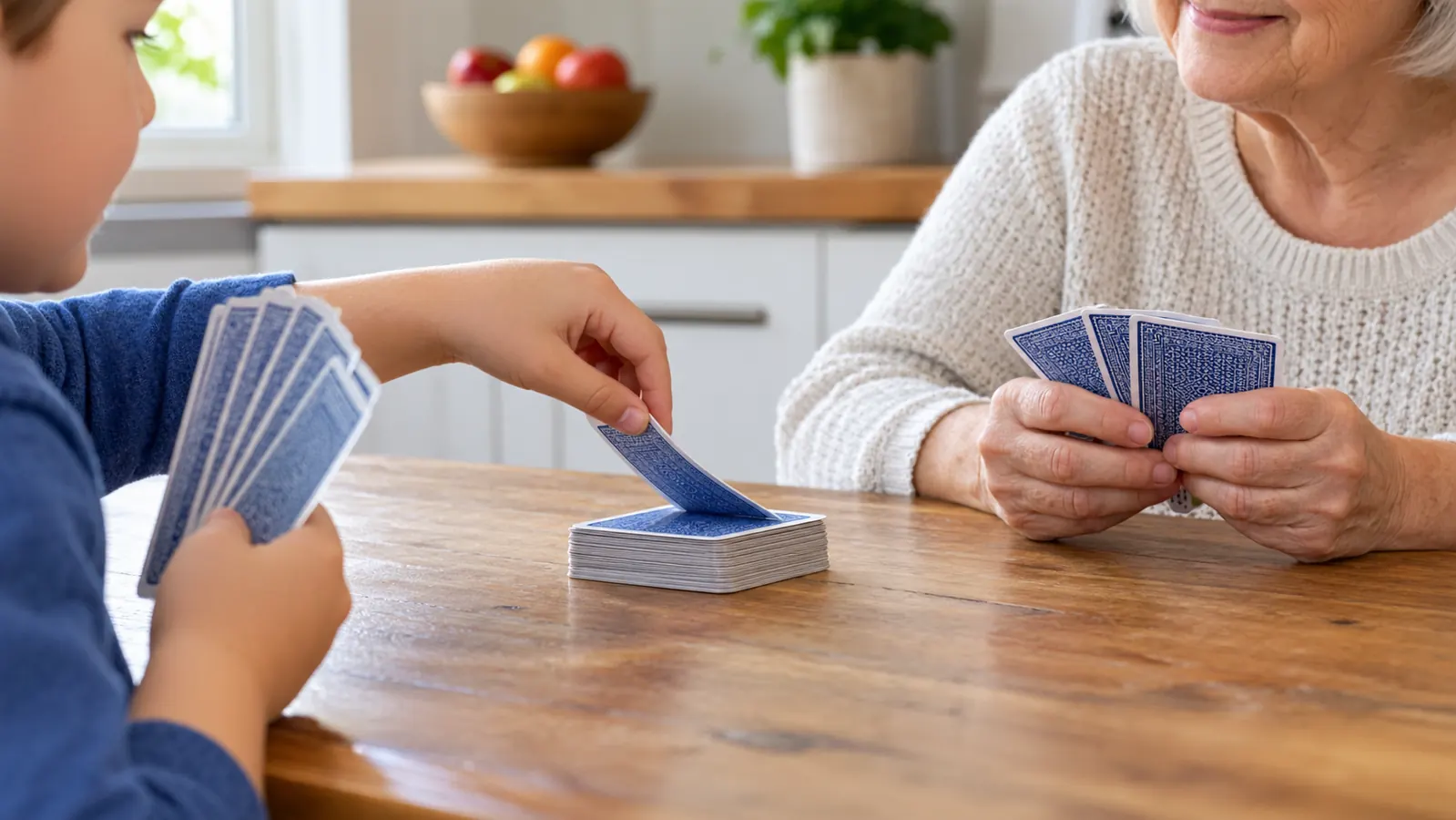
The third thing is the reading level. The box says ages seven and up, and that is roughly right, but the Nope card and the Favor card both require reading and a little logic. Rosie cannot read the card text yet, so she plays from the pictures, and the pictures do not explain a Nope card. We taught her that a Nope card means 'the card that says no to someone else's card,' and she gets it now, but the first few games she asked what everything did. If you have a child under six, plan to explain the whole game every round for a while. It is not a dealbreaker, but it is real work, and nobody mentions it on the box.
The last thing nobody tells you is that the game can feel personal. The Attack card forces someone to draw twice, the Favor card makes a player hand over a card, and the Shuffle card reorders the deck so someone's plan falls apart. All of it gives players ways to single out one person, and at our table that person is usually Frank, because the kids think it is hilarious to make him draw. He takes it well, but I have seen it go the other way at other tables, so it is worth knowing before you play with someone who does not enjoy being picked on.
How the Deck Holds Up After Eight Months
I judge a game by how the box looks after fifty plays, because I spent the 90s trading video games that either held up or got returned, and the same logic applies to a card deck. After eight months of Sunday nights, our Exploding Kittens deck has been shuffled, dropped, bent, and once sent through the washing machine in a hoodie pocket. The cards still look new. They are thick and glossy, the corners have not peeled, and the ink has not faded, which is more than I can say for the Uno deck we replaced last winter.
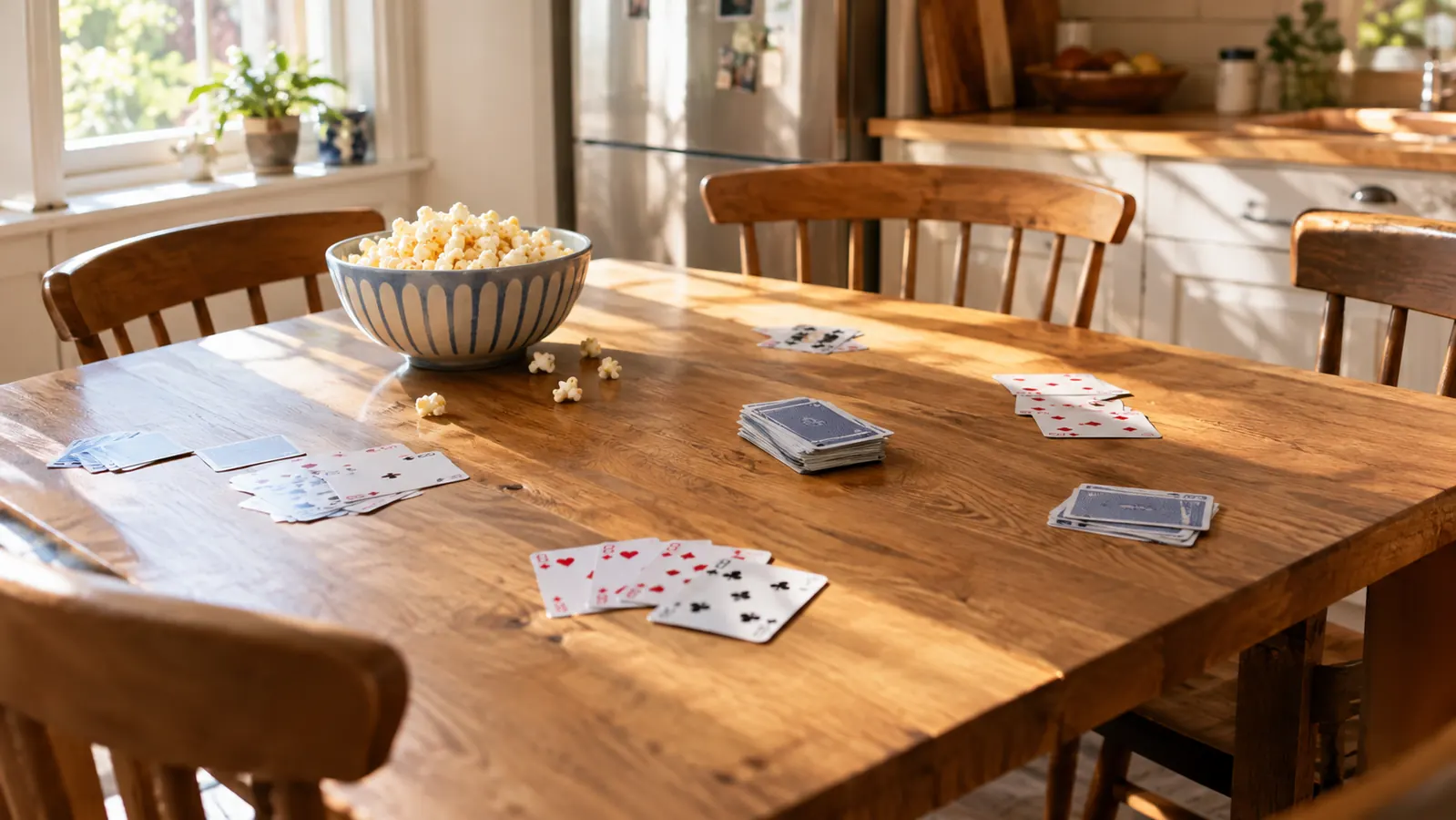
The box itself is the weak point. It is a sturdy little box, but it is small, and we stopped putting the cards back in it after the second month. The deck lives in a zippered pouch on the den bookshelf, because with five people around the table the box flaps get in the way and cards go everywhere. If you buy this, buy a card pouch or a bag that closes. That is the kind of practical detail that never makes it onto the packaging, and it is the difference between a game that gets played and a game that gets abandoned because the box is annoying.
One more component note: the original edition comes with a fixed set of cards, and you will know them all within a few games. There are no hidden surprises, and you do not need expansions to enjoy it. The game does not need more cards. It needs the ones it has, played fast, with people who are willing to laugh when they explode.
A round takes about ten minutes, a six-year-old can win it, and eight months later my grandkids still ask for the game by name. That is a better record than most boxes on our shelf.
How Player Count Changes the Game
The box says two to five players, and that range is honest, but the experience changes more than you would expect. At five players, the game is chaos in the best way. More cards are in play, more Nope cards fly around, and the explosions come fast. At three players, it becomes a more tactical game, because you can track what everyone is holding and the Defuse cards matter more. Two players is the weakest setting. The humor and the chaos both shrink, and a round becomes a quick draw-and-hope contest that does not show the game at its best.
Our table is usually five, which is the sweet spot, and I would recommend you play this with at least three. If you are a couple looking for a two-player card game, there are better choices, and I would not buy this one for that purpose. If you have three, four, or five people at the table, this is one of the best uses of a deck of cards I have found in years. The short rounds mean everyone gets a turn to be the winner, and the luck means the winner is not always the oldest person at the table. For a family with kids, that is worth a lot.
The Strategy Question, From Someone Who Played Video Games in the 90s
I have a low tolerance for games that pretend to be strategic and are actually luck with a theme, because I spent years watching my own kids play video games that rewarded real skill. Exploding Kittens is neither pure luck nor deep strategy. It is a push-your-luck game with a hand you can manage, and the skill is in knowing when to play a card and when to hold it. The Defuse card is the heart of it. You can count the Defuse cards in your hand, but you never know how many are left in the deck, and that uncertainty is where the tension lives. The best turns are the ones where someone has one Defuse left and has to decide whether to draw or to make someone else draw instead.
Maya figured this out by the second month and started winning more than her share. I have started tracking which cards have been played, the way I counted coins in my pocket as a kid, and it works. But here is the honest part: this is not chess, and it is not even Uno with better art. It is a party game with a strategy layer, and if you bring a serious gamer to the table they may find it thin. The replay value comes from the people, not the deck. With the right group, a round is funny and tense and over in ten minutes. With the wrong group, it is a game of drawing cards and waiting. That is true of most games, but it is more true here, because the rounds are so short that the group chemistry matters every single time.
My favorite moment of the whole eight months happened in January. Maya was down to one Defuse card, and instead of playing it safe, she played an Attack card to force Frank to draw two, then used See the Future to peek at the top three cards, then passed her turn without drawing. Frank exploded on the second card, and Maya sat there grinning with her one Defuse card still in her hand. It was a genuinely clever sequence, and it showed me the game has more depth than the cartoons suggest.
What I Liked
- Rounds usually finish in under ten minutes, so a bad game never drags
- A six-year-old can genuinely beat a twelve-year-old, and both will want a rematch
- The cards are thick and have survived eight months of weekly shuffling, plus one trip through the washing machine
- The humor is genuinely funny for kids and adults, which is rarer than it sounds
Where It Falls Short
- Player elimination means someone sits out every round, and younger kids take it hard
- Luck outweighs strategy more than the marketing suggests
- The Nope and Favor cards require reading, so kids under six need help every game
- The small box is awkward at the table; plan on a card pouch instead
Who This Is For
Buy Exploding Kittens if you run a table with mixed ages and you need something that plays fast and gives the youngest player a real chance. It is the best game we added this year for exactly that reason: a six-year-old and a twelve-year-old can sit at the same table, and the luck evens the field so Rosie genuinely wins sometimes. It is also a good first game for a child learning to lose gracefully, because losing is funny and the next round starts right away. If your game night has stalled and you want something that takes ten minutes to learn and ten minutes to play, this is a strong choice.
Who Should Skip It
Skip it if you want a deep strategy game, because the deck has a real luck ceiling and a serious gamer will hit it fast. Skip it if you are a household of two, because the two-player game loses most of the chaos and most of the humor. And skip it if you have kids younger than six, because the reading requirement means you will spend the whole game explaining cards. For everyone else, this is a genuinely fun game that has earned a permanent spot on our shelf, which is the highest compliment I can give a box of cards.
The Game That Earned a Permanent Spot on Our Shelf
Eight months of Sunday nights says Exploding Kittens is more than a trend. If your game night needs a fast, funny card game that works across three generations, this is the one we reach for first.
Amazon Check Today's Price on Amazon →