
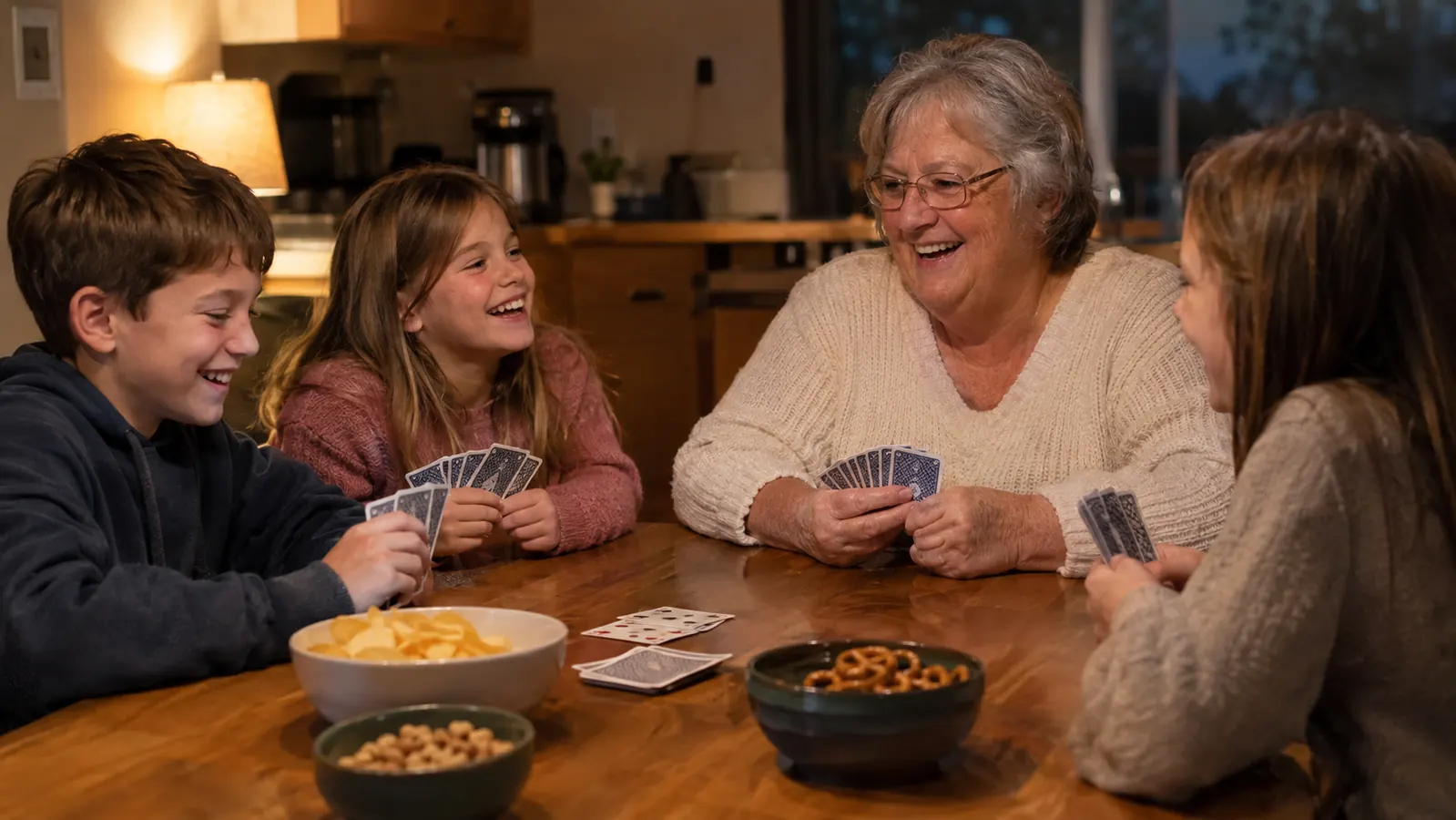
Sunday game night at our house runs on a simple rule: everybody plays, or nobody plays. That rule has retired more game boxes than I can count. Maya, at twelve, wants strategy and a little drama. Eli, at nine, wants to win without reading a page of instructions. Rosie, at six, wants to be included and never feel like she is just watching. For years, I watched perfectly good games land in the donation pile because they could not hold all three at once. Then one of my kids dropped off a copy of Exploding Kittens on the way out the door and said, "just try it."
I read the rulebook cover to cover before the kids arrived, the way I always do. It took about four minutes, and I thought, that cannot be the whole game. Six months later, Exploding Kittens is still the first box pulled off the bookshelf on Sunday nights, and I have stopped being surprised. I keep a tally in the notebook I use for grocery lists, and we are past fifty plays. This is the honest long-term review I wish someone had handed me before the first shuffle.
The Quick Verdict
A fast, funny card game that genuinely works for a 6-year-old, a 9-year-old, and a 12-year-old at the same table. Setup takes under a minute, a round runs ten to fifteen minutes, and it is still getting laughs past fifty plays.
Amazon Check Today's Price →The box my grandkids pull off the shelf themselves
Six months in, Exploding Kittens is the most-requested game at our table, and the kids grab it without being asked. If you host game night for mixed ages, check the current price on Amazon and see if it earns a spot on your shelf.
Amazon Check Today's Price on Amazon →How I've Used It
Our Sunday game nights start around five, after supper and before bedtime, at the oak kitchen table that seats six. Frank sits at the end, half-watching whatever game is on the little TV in the den, until Rosie hands him a hand of cards and he is in. The games live on a bookshelf in the den, and Exploding Kittens has spent six months on the bottom shelf at kid height because it is the box they pull out themselves.
I would guess we have played it somewhere between fifty and sixty times since April. Some nights we play three rounds in a row. Some nights we play one round and the kids wander off, and Frank and I play a quick two-player game after they are in bed. That is the part I did not expect from a game marketed to kids: it holds up as a two-player game for two adults too.
I time everything, because forty years of hosting does that to a person. Setup takes under a minute. Shuffle, deal, done. A full round with five players runs ten to fifteen minutes, and our longest round ever, with five players all counting cards and second-guessing each other, was over in about twenty.
What's in the Box and How a Round Works
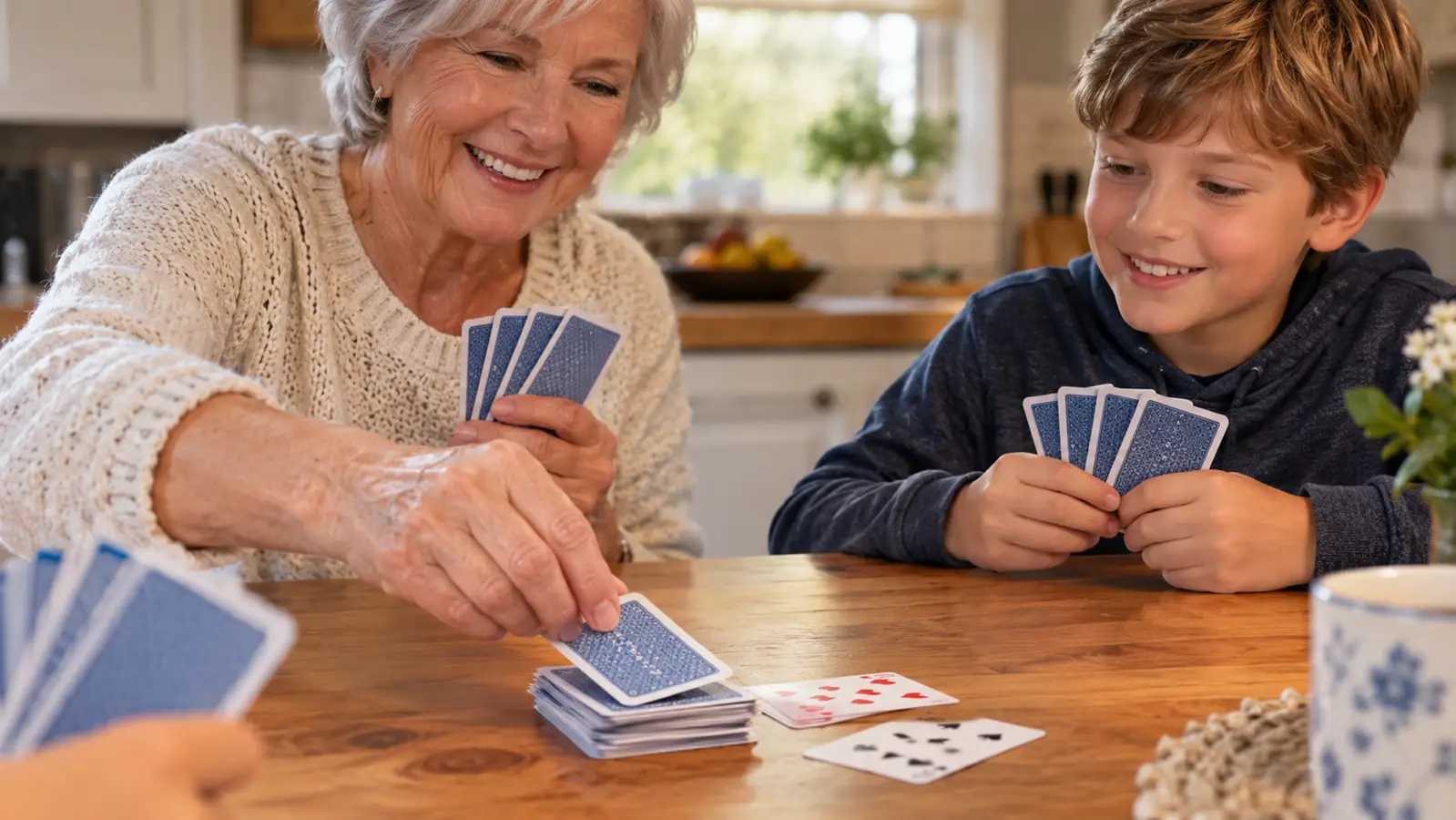
The rules fit on a single card, which tells you a lot about the game. Players take turns drawing from a central pile. Somewhere in the deck are several Exploding Kitten cards, and drawing one without a defuse card puts you out of the round. Everything else in the deck is the arsenal: skip a turn, peek at the next card, steal a card from another player, or shuffle the pile so somebody else has to take the risk.
The first time we played, I handed the rules card to Maya and said, "read this out loud." Maya read it in under a minute. Eli had it down by the second round. Rosie needed three rounds, but once the icons on the cards clicked, Rosie stopped asking what anything did. There are no points, no scorekeeping, and no phases. You draw, you act, you pass. A six-year-old can hold the whole game in her head, and that is exactly what makes it work at our table.
The components surprised me for a game at this price. The cards are thick, the finish is smooth, and after six months of shuffling by hands that are not always gentle, not one card has bent, split, or peeled at the corner. The box has held up too, which matters because it lives on a low shelf where a six-year-old pulls it out at least once a week.
How It Plays With a 6-Year-Old, a 9-Year-Old, and a 12-Year-Old
This is the part I care about most, because it is where most family games fall apart. Maya likes games with a little strategy and a little luck, and this one delivers both. Maya keeps track of which cards have been played, so she knows when the deck is getting dangerous. That is a real skill, and it has sharpened over the months. Maya has also gotten better at losing, because the rounds are short enough that the sting never lasts.
Eli plays to win and reads every card carefully. Eli figured out early that the steal card is the most powerful thing in the deck and uses it on whoever is holding a defuse card. Watching a nine-year-old scheme like that is half the fun of the game. It rewards attention, and attention is exactly what does not come naturally after a long school week.
Rosie is the reason most games fail, and Rosie is the reason this one works. Rosie cannot read every card yet, but the icons are clear enough that she plays without help. She wins about as often as anyone else, because the game does not care how old you are. The moment that sold me was the Sunday she drew the card that knocked Frank out of the round, looked him dead in the eye, and said, "better luck next time, Grandpa." He laughed for five minutes.
I will also say the game has taught Rosie something useful about losing. She does not love it, but a round only lasts ten minutes, so the wait for revenge is short. Watching her learn to shrug and deal the next round has been worth the price of the box all by itself.
Replay Value After Fifty Plays
I grew up on video games with my own kids in the nineties, so I judge a game by how it holds up after the novelty wears off. Exploding Kittens has passed the fifty-play mark at our table, and it is still the box they ask for. The reason is the deck itself. Every round reshuffles the cards, and the order changes how you play. Sometimes the steal cards come out early and everybody hoards. Sometimes they come out late and everybody gambles.
The player count changes the game too. With two players, it is a quick duel of memory and nerve. With five, it is chaos, because the deck is packed and the odds are harder to track. We play at three, four, and five players depending on who shows up on a Sunday, and each version feels like its own game. That is the mark of a good design, and I say that as someone who spent the nineties arguing about frame rates and save points.
We have also tried one of the expansions, and it is worth knowing that the base game stands completely on its own. The expansions add new cards and new ways to mess with each other, and we save them for holiday game nights so they stay special. If you never buy another card, the base deck is a complete game. That is not true of every card game that sells expansions, and I respect it.
How It Sits Next to the Other Games on Our Shelf
We own a shelf full of family games, and Exploding Kittens has carved out a specific job. UNO lives on our shelf too, and it is the game the kids reach for when they want something familiar. This one gets picked when they want something where the tension is real and the laughs are louder. They are different nights, and I would not want to lose either box.
The games that fail on our shelf fail for the same reason: they ask too much of the youngest player. This one asks almost nothing. Rosie does not need to read, does not need to count, does not need to remember a sequence of actions. She needs to draw a card and decide whether to use the card in her hand. That is the entire ask, and it is why the game survives contact with a six-year-old.
The other thing that keeps it on the shelf is the length. A game that takes an hour is a commitment, and commitments get postponed. Ten minutes fits between clearing the plates and the first bedtime argument. We have played this game on school nights, which is something I can say about almost nothing else we own.
What Wears Down and What Doesn't
After six months, I can tell you exactly what holds up and what does not. The cards hold up. We shuffle hard, we deal across a wooden table, and we have had the occasional drink spill. One card has a permanent coffee ring, and it still shuffles fine. The box shows more wear than the cards do, which is the opposite of most games we own.
The rule card has been read by every adult who has ever sat down to play, and it is still in one piece. The honest weak spot is storage. The cards fit fine when the box sits flat, but the insert does not hold them snug once the shrink wrap is off, and when the box sits on its side, the cards slide around. A rubber band around the deck has solved it completely.
The other honest note is about the tone. The card names are silly on purpose, and the whole point is to make people laugh while the tension builds. That works beautifully with our grandkids, and it works with the adults too, mostly because the adults enjoy watching the kids react. It is not a game with deep themes or a long story arc. It does not want to be. It wants to make a kitchen table laugh for fifteen minutes, and it does that every single Sunday.
What I Liked
- The rules explain in a minute and a round plays in ten to fifteen
- A 6-year-old, a 9-year-old, and a 12-year-old can all play together
- Real strategy for older players: memory, odds, and knowing when to steal
- Still getting laughs after fifty-plus plays
- Works for two players as well as five
- No scorekeeping, no long rules lecture, no setup
Where It Falls Short
- Knocked-out players can sit through the rest of a long round
- A player who tracks the deck can build an edge that frustrates the youngest kids
- Cards slide around in the box unless you keep the deck banded
- The tone is silly on purpose, not for tables that want a serious strategy game
Six months and fifty-plus plays later, it is still the first box pulled off the shelf on Sunday nights.
Who This Is For
Buy it for a household with kids roughly six to twelve who need a game that everyone can play without a long rules lecture. Buy it if your game night keeps stalling because half the table is bored and half is lost. Buy it if you want something that fits between supper and bedtime, sets up in under a minute, and lets a six-year-old win as often as a twelve-year-old. And buy it if you are the grandparent who hosts, because it is one of the few games I own that the kids pull off the shelf themselves.
If your group is adults only, it still works. We have played it with neighbors after the kids went to bed, and it held up fine. It is the rare game that scales from a six-year-old's birthday to a grown-up dinner table without changing a single rule.
Who Should Skip It
Skip it if your table wants a deep strategy game with a long arc, because this one is light and random by design. Skip it if you dislike games where players get knocked out before the round ends, because that happens in every round. Skip it if your youngest players are not ready to sit out and watch, because the waiting is the one real downside. And skip it if you want a game that fills an entire evening. Exploding Kittens is built for ten-minute bursts, and it is at its best when you treat it that way.
One more note for the adults reading this: if you are hoping for a game that rewards deep planning the way a good video game does, this is not that. The best players win more often, but the random draw always has a vote. We love that about it on a Sunday night. If it would drive you up a wall, you have been warned.
Give your table a game the kids pull out themselves
After six months and fifty-plus plays, Exploding Kittens is still the most-requested box on our shelf. If your game night needs something that works for every age at the table, check today's price on Amazon.
Amazon Check Today's Price on Amazon →